

Showing posts with label liturgy. Show all posts
Showing posts with label liturgy. Show all posts
Monday, January 23, 2012
Monday, January 16, 2012
How clean can you kiss a leper?
Every once in a while, a row will be kicked up concerning the liturgy by a group of parishioners who don't like the Latin, hate a bigger church with younger people and don't care for change at all.
Hrmmmm...
A group of old white people who hate foreign language, expansion of borders, young people and change?
Wow.
We gots Tea Party!
But yesterday, we sang a few congregational songs that should surely soothe the savage beasts.
One of the songs we chose has sort of a sing-songy melody and a little Janet Jacksony.
The song is called "The Summons" and the melody is an old Scottish theme called "Kelvingrove".
I did a little looking into Kelvingrove and found out that it's the tune of a ditty called "Oh the Shearin's No' for You". Which isn't about sheep, as the singers of "Burning Bridget Cleary" say in their intro to our next video, it's about a man who tells his wife "she's too old for fun". Give a listen.
Further back, as if that song weren't dreary enough, it seems the original tune was about a rape. The story is how the victim was forced to marry her assailant as she was pregnant from the attack:
Well I'll no kill you deid my bonnie lassie o
No I'll no kill you deid my bonnie lassie o
No I'll no kill you deid, nor will I harm your pretty heid
I will marry you with speed my bonnie lassie o
I guess marriage is better than being deid.
The liturgical adaptation of Kelvingrove, The Summons, has some equally disturbing bits to it.
No, the disturbing part isn't the rapid fire old folks chorus or the womyn priestess. It's the overabundance of loving, touching and leper-kissing that skeeves me out.
Will you let the blinded see
If I but call your name?
Will you set the pris’ners free
And never be the same?
Will you kiss the leper clean,
And do such as this unseen,
And admit to what I mean
In you and you in me?
Will you love the ‘you’ you hide
If I but call your name?
Will you quell the fear inside
And never be the same?
Will you use the faith you’ve found
To reshape the world around,
Through my sight and touch and sound
In you and you in me?
Is it just me or when a guy sings that song and even if you know it's about Jesus it makes Jesus seem creepy and needy? And a bad pick up artist.
And to the demands of Lord Touchtouchmethere, I have to answer a resounding "NO". I ain't kissing no lepers clean. I don't think I can. I don't even think I'm canonically allowed to kiss a clean leper.
And who's the 'you' I'm hiding? And why is the 'you' in quotes? What makes that you so special?
I'd expect better out of the composer. I mean, this from the guy who sang "Christmas Katie" and "Can't Get High"?
Oh..wait...wrong John Bell.
This is the John Bell who wrote it.
John Bell is the most prolific composer of liturgical music from Scotland's Iona Community; his songs are noted equally for their solid theology, their concern for justice, and their ease for congregational singing. His work is distributed in the U.S. by GIA Publications
Iona. Justice. Congregational Singing. GIA. Wow, even Widespread would think this is too far out.
Ughh. There is nothing wholly scriptural, catechetical or just about this song. If I was in a park or maybe a skate park and sang it, I'd be tazered and Batman'd. Litmus test for Jesus songs: You can sing them around children without being pepper sprayed. This one fails.
Liturgical music for a while was all about touching, hugging and dancing but, to quote the old song:
Tak' the buckles frae yer shoon, my bonnie lassie o
Tak' the buckles frae yer shoon, my bonnie lassie o
Tak' the buckles frae yer shoon, for you've married sic a loon
An' yer dancin' days are done, my bonnie lassie o
Hrmmmm...
A group of old white people who hate foreign language, expansion of borders, young people and change?
Wow.
We gots Tea Party!
But yesterday, we sang a few congregational songs that should surely soothe the savage beasts.
One of the songs we chose has sort of a sing-songy melody and a little Janet Jacksony.
The song is called "The Summons" and the melody is an old Scottish theme called "Kelvingrove".
I did a little looking into Kelvingrove and found out that it's the tune of a ditty called "Oh the Shearin's No' for You". Which isn't about sheep, as the singers of "Burning Bridget Cleary" say in their intro to our next video, it's about a man who tells his wife "she's too old for fun". Give a listen.
Further back, as if that song weren't dreary enough, it seems the original tune was about a rape. The story is how the victim was forced to marry her assailant as she was pregnant from the attack:
Well I'll no kill you deid my bonnie lassie o
No I'll no kill you deid my bonnie lassie o
No I'll no kill you deid, nor will I harm your pretty heid
I will marry you with speed my bonnie lassie o
I guess marriage is better than being deid.
The liturgical adaptation of Kelvingrove, The Summons, has some equally disturbing bits to it.
No, the disturbing part isn't the rapid fire old folks chorus or the womyn priestess. It's the overabundance of loving, touching and leper-kissing that skeeves me out.
Will you let the blinded see
If I but call your name?
Will you set the pris’ners free
And never be the same?
Will you kiss the leper clean,
And do such as this unseen,
And admit to what I mean
In you and you in me?
Will you love the ‘you’ you hide
If I but call your name?
Will you quell the fear inside
And never be the same?
Will you use the faith you’ve found
To reshape the world around,
Through my sight and touch and sound
In you and you in me?
Is it just me or when a guy sings that song and even if you know it's about Jesus it makes Jesus seem creepy and needy? And a bad pick up artist.
And to the demands of Lord Touchtouchmethere, I have to answer a resounding "NO". I ain't kissing no lepers clean. I don't think I can. I don't even think I'm canonically allowed to kiss a clean leper.
And who's the 'you' I'm hiding? And why is the 'you' in quotes? What makes that you so special?
I'd expect better out of the composer. I mean, this from the guy who sang "Christmas Katie" and "Can't Get High"?
 |
| John Bell of Widespread Panic |
Oh..wait...wrong John Bell.
This is the John Bell who wrote it.
John Bell is the most prolific composer of liturgical music from Scotland's Iona Community; his songs are noted equally for their solid theology, their concern for justice, and their ease for congregational singing. His work is distributed in the U.S. by GIA Publications
Iona. Justice. Congregational Singing. GIA. Wow, even Widespread would think this is too far out.
Ughh. There is nothing wholly scriptural, catechetical or just about this song. If I was in a park or maybe a skate park and sang it, I'd be tazered and Batman'd. Litmus test for Jesus songs: You can sing them around children without being pepper sprayed. This one fails.
Liturgical music for a while was all about touching, hugging and dancing but, to quote the old song:
Tak' the buckles frae yer shoon, my bonnie lassie o
Tak' the buckles frae yer shoon, my bonnie lassie o
Tak' the buckles frae yer shoon, for you've married sic a loon
An' yer dancin' days are done, my bonnie lassie o


Saturday, January 14, 2012
Happy Festum Asinorum!
 |
| The Venerable Ass |
The 'Festival of the Ass,' and other religious burlesques of a similar description, derive their origin from Constantinople; being instituted by the Patriarch Theophylact, with the design of weaning the people's minds from pagan ceremonies, particularly the Bacchanalian and calendary observances, by the substitution of Christian spectacles, partaking of a similar spirit of licentiousness,—a principle of accommodation to the manners and prejudices of an ignorant people, which led to a still further adoption of rites, more or less imitated from the pagans. According to the pagan mythology, an ass, by its braying, saved Vesta from brutal violence, and, in consequence, ' the coronation of the ass ' formed a part of the ceremonial feast of the chaste goddess.
An elaborate sculpture, representing a kneeling ass, in the church of St. Anthony at Padua, is said to commemorate a miracle that once took place in that city. It appears that one morning, as St. Anthony was carrying the sacrament to a dying person, some profane Jews refused to kneel as the sacred vessels were borne past them. But they were soon rebuked and put to contrition and shame, by seeing a pious ass kneel devoutly in honour of the host. The Jews, converted by this miracle, caused the sculpture to be erected in the church. It takes but little to make a miracle.
http://www.thebookofdays.com/months/jan/14.htm
An elaborate sculpture, representing a kneeling ass, in the church of St. Anthony at Padua, is said to commemorate a miracle that once took place in that city. It appears that one morning, as St. Anthony was carrying the sacrament to a dying person, some profane Jews refused to kneel as the sacred vessels were borne past them. But they were soon rebuked and put to contrition and shame, by seeing a pious ass kneel devoutly in honour of the host. The Jews, converted by this miracle, caused the sculpture to be erected in the church. It takes but little to make a miracle.
http://www.thebookofdays.com/months/jan/14.htm
There also was a corruption of the liturgy on this feast day that went like this:
Mass was continued, and at its end, apparently without awakening the least consciousness of its impropriety, the following direction (in Latin) was observed: In fine Missae sacerdos, versus ad populum, vice 'Ite, Missa est', ter hinhannabit: populus vero, vice 'Deo Gratias', ter respondebit, 'Hinham, hinham, hinham.'(At the end of Mass, the priest, having turned to the people, in lieu of saying the 'Ite missa est', will bray thrice; the people instead of replying 'Deo Gratias' say, 'Hinham, hinham, hinham.')*
The more things change...
I made up some downloadable Feast Day cards for all of you to print up and, maybe this Sunday, pass on to your Ass at Mass (rhymes!)!
I made up some downloadable Feast Day cards for all of you to print up and, maybe this Sunday, pass on to your Ass at Mass (rhymes!)!


 |
| Front |
 |
| Back |

Tuesday, January 3, 2012
The liturgy is to blow the mind
 |
| Hogwarts liturgy? |
The 84-year-old Benedict looked tired during Mass, but his voice was strong, and he smiled and chatted briefly with families and young children who carried gifts to him during the ceremony. He seemed amused by one pacifier-sucking infant as the parents kneeled before the pope.
WHAAAAAAAAAAAAAAT? Womyn children dressed as the magi? And the pope CHATTING with the gift bearers?
Oh, Roman Liturgy, I love you. I just do.
Monday, January 2, 2012
A New Year and a new path home...
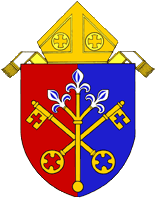
On the technical side of things, a personal ordinariate is a Church structure similar to a diocese, but one that is nation-wide and led by an "ordinary" (a priest or a bishop) who is answerable directly to the Pope. Much like a diocese, an ordinariate has parish churches, priests and faithful. Naturally, the parishes that will be part of the Anglican ordinariate will preserve Anglican forms of worship and governance while being fully "Catholic" in their faith and in their relationship to the Successor of Peter (i.e. the Pope).
The first Anglican ordinariate, named Our Lady of Walsingham, was established last January in England and Wales. Yesterday, it was announced that the U.S. version is called the Personal Ordinariate of the Chair of St. Peter and it will be headquartered in Houston, Texas at Our Lady of Walsingham Church. Fr. Jeffrey Steenson, formerly the Episcopal Bishop of the Rio Grande but now a Catholic priest, will be the ordinary for the structure in the U.S.
For the vast majority of American Catholics, this development will not mean a whole lot. As you travel to different cities in the future and look for a place to fulfill your Sunday obligation to attend Mass, however, you might now have a few more choices. But from a Southern perspective, the birth of the ordinariate is interesting because many of the long-established Anglican parishes and groups who are lined up to join the Church through the ordinariate are in Southern states - especially Florida and Texas (the latter of which is the birthplace of Anglican Use Catholic parishes). You can take a look at the unofficial Google map of these communities.
Pray for these brothers and sisters of our who are beginning their journey into the Catholic fold and pray for our Holy Father, Pope Benedict, who is the Pope of Christian unity!
Wednesday, December 21, 2011
Solstice, man
 |
| Winter Solstice at Stonehenge. Wow, that's funny cuz it's "STONE" henge. |
The time around December 21 or 22 is a very important day for our planet and its relationship with the sun. December 21 is one of two solstices, days when the rays of the sun directly strike one of the two tropical latitude lines. In 2011 at precisely 12:30 a.m. EST (05:30 UTC) on December 22, 2011 winter begins in the Northern Hemisphere and summer begins in the Southern Hemisphere.
The earth spins around its axis, an imaginary line going right through the planet between the north and south poles. The axis is tilted somewhat off the plane of the earth's revolution around the sun. The tilt of the axis is 23.5 degrees; thanks to this tilt, we enjoy the four seasons. For several months of the year, one half of the earth receives more direct rays of the sun than the other half.
The earth's axis always points to the same point in the universe. When the axis points away from the sun from December to March (because of the relative location of the earth to the sun), the southern hemisphere enjoys the direct rays of the sun during their summer months. Alternatively, when the axis tilts towards the sun, as it does between June and September, it is summer in the northern hemisphere but winter in the southern hemisphere.
December 21 is called the winter solstice in the Northern Hemisphere and simultaneously the summer solstice in the Southern Hemisphere. On June 21 the solstices are reversed and summer begins in the northern hemisphere.
http://geography.about.com/cs/calendarsseason/a/winter.htm
Most liturgical texts will tell you that the two solstices are the basis of the dates set for Christmas and the Birth of St. John the Baptist.
For Christmas, this may be coincidental with the "birth of the unconquerable sun" (natalis invicti), a feast commemorating the birth of Apollo the Sun God who will overcome the darkness with his birth. The shortest day of the year, the darkest day, will be overtaken by the sun. The connection to the "Son" of God is obvious. Pope Benedict has written that the date of Christmas, December 25th, is due to the Annunciation being set at March 25th thus not falling on the date of solstice.
 |
| Sol Invictus/Apollo rising |
Tuesday, December 20, 2011
Ineffable: It finally happened
 From back in 2008:
(Erie Bishop Donald) Trautman said the draft (of the Roman Missal) includes words such as "ineffable" that would not be in the ordinary vocabulary of people.
"This should be the prayer of the people," Trautman said. "I'm not for having street language. ... We should certainly have elevated tone, but words like that are just beyond the common comprehension."
Catholics coming out of a lunchtime Mass at Erie's St. Peter Cathedral weren't familiar with "ineffable."
Welp, today I finally got to use the word that lunchtime Massgoers in Erie, PA cannot understand. The collect reads:
O God, eternal majesty, whose ineffable Word
the immaculate Virgin received through
the message of an Angel
and so became the dwelling-place of divinity,
filled with the light of the Holy Spirit,
grant, we pray, by her example
we may in humility hold fast to your will.
Through Our Lord Jesus Christ....
No complaints. No worries. No confusion. The early Massgoers in Oxford, MS listened to the collect probably about as closely as they have in the past.
"Beyond common comprehension"? Ineffa-believable!
The Liturgy as P.F. Chang's
The Hispanic Mass. The multicultural liturgy for Pentecost. The diversity of song and dance for the contemporary Mass. Catholics in America have become used to "festive" liturgies and other ways that highlight the global family we are.
When I was in seminary, it seemed that monthly we'd have a cultural Mass with afterwards, no kidding, a dinner highlighting the central culture's food..Among the kultur-Masses was an African Mass (which is a continent, by the way), a German Mass, a Chinese Mass, and a very ill-advised African-American Mass which had our rector intoning the Mass parts in a vaudeville baritone.
I'm not a fan of multicultural. It's silly. But I usually don't say much about the silliness because it's sort of the thing to do and I may come off as sort of a xenophobe. Which I may be. But the silly?
I'm more confident in the silliness now after reading this article Sunday.
This USM professor, Andrew Haley, provokes the reader to think of how all this multicultural food appeared and what does it say about our tastes (pun intended) as a culture? Well, it says we're middle class! Which is not a bad thing to be culturally. But awful as THE BRIDE OF CHRIST! The Church should not be reflective of any social "taste" or "trend" nor should she be "middle" anything. But I am afraid we have become very middle (and slipping).
The love of all things diverse is obvious. Just look at the excitement "anglos" have over the Guadalupe Fiestas of last week. That's not about our faith. It's about being entertained culturally. Or feeling very cosmopolitan but not having to travel. Haley says this in the article that has some good value to the way we think of our Liturgies and Mass:
"I would argue that in the 19th century American culture is shaped by upper class elite taste, whereas in the 20th century the middle class has come to define how we eat, the music we listen to, the way we dress," Haley said.It's also changed the food landscape of places like our very own Hattiesburg. Ever wonder why you have your pick of Thai, Middle Eastern, Japanese, Chinese and Italian restaurants in the heart of a Southern city?"
Haley goes on to say that the restaurants don't exist for the cultures that produced the food but for the middle class, largely white people, who desire the exotic tastes. Sound familiar?
The book is called "Turning the Tables". Interesting title in context. Maybe our tables need to be turned..back and our culture as Catholics be put in the class we deserve.
 |
| Danza! Danza! Danza! |
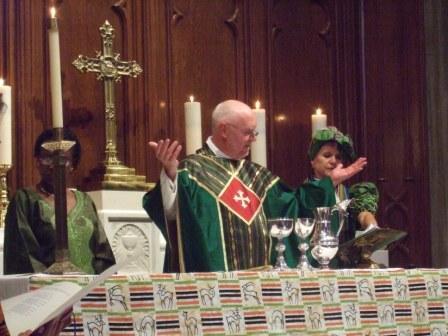 |
| Hip young priest celebrates Mass in Kinte Cloth reflecting his heritage...emm...broadmindedness. |
I'm more confident in the silliness now after reading this article Sunday.
 |
| Professor Haley's book |
The love of all things diverse is obvious. Just look at the excitement "anglos" have over the Guadalupe Fiestas of last week. That's not about our faith. It's about being entertained culturally. Or feeling very cosmopolitan but not having to travel. Haley says this in the article that has some good value to the way we think of our Liturgies and Mass:
"I would argue that in the 19th century American culture is shaped by upper class elite taste, whereas in the 20th century the middle class has come to define how we eat, the music we listen to, the way we dress," Haley said.It's also changed the food landscape of places like our very own Hattiesburg. Ever wonder why you have your pick of Thai, Middle Eastern, Japanese, Chinese and Italian restaurants in the heart of a Southern city?"
Haley goes on to say that the restaurants don't exist for the cultures that produced the food but for the middle class, largely white people, who desire the exotic tastes. Sound familiar?
The book is called "Turning the Tables". Interesting title in context. Maybe our tables need to be turned..back and our culture as Catholics be put in the class we deserve.
Sunday, December 18, 2011
Ero Cras
 |
| Graphic from Bethany Twins Blog |
The "O Antiphons" also possibly share in this conspiracy of symbols and signs. A few publications have written about the hidden message in the traditional chant. Take this article for example:
What a great treasure the liturgical tradition of the Roman Rite has left us in the O Antiphons of the Advent season. These are the very antiphons, still used in the current Liturgy of the Hours, which surround the Magnificat at Evening Prayer (Vespers) from December 17 - 23. They are seven titles for Christ, the Messiah, drawn from Hebrew Scripture, representing a "mosaic" of the Old Testament.
- O Sapientia [Wisdom]
- O Adonai [Lord]
- O Radix Jesse [Root of Jesse]
- O Clavis David [Key of David]
- O Oriens [Dayspring]
- O Rex gentium [King of the Nations]
- O Emmanuel [God-with-Us]
Their themes are broadly messianic, stressing the brightness of hope. Jesus is invoked under a series of titles, drawn largely from Isaiah, but in a sequence that must be intentional. They move historically from the beginning, before creation, to the very gates of Bethlehem. It seems more than coincidental, too, that the titles given to Jesus make an acrostic in Latin, which when read backwards means: "I will be tomorrow" ("Ero Cras") -- an obvious (at least to the medieval mind) allusion to Christmas eve.
Pretty cool.
Wednesday, December 14, 2011
NO CHRISTMAS DECORATIONS!!!
It was sort of a non-issue growing up. When my mom was ready, she'd go up in the attic and we'd pull out the Christmas decorations; tree ornaments, garlands, plastic elves (my favorite!), felt reindeer, and so on and put them up. Just did it. Maybe a week or two before Christmas. We'd get our tree from the high school's Christmas tree sale where old Mr. Radigan would take our money and offer us coffee. That was about 2 weeks before Christmas. All was calm, all was bright.
Then it seemed that priests and sisters and lay minsters began to say with the DOGMATIC AUTHORITY OF STUFF THAT THEY HEARD IN A WORKSHOP: "NO CHRISTMAS DECORATIONS BEFORE CHRISTMAS!" The offense they'd take when they'd see a creche or a reindeer in a church office would throw them into a liturgical rant unlike (seriously) any they have at any other time of year! Even some priests said, "NO CHRISTMAS PARTIES! WE CALL THEM 'ADVENT PARTIES'". When you take the "Christmas" out of "Christmas" party, even though it's all the same thing, it still sucks a little bit more.
So anyway, I saw this picture today of the Pope. Today. The Pope.

Pope Benedict XVI leads his general audience in Paul VI hall at the Vatican Dec. 14. The hall's Nativity scene was handcrafted in Mexico. The Christmas tree is from Ukraine. (CNS/Paul Haring)
So, there.
Then it seemed that priests and sisters and lay minsters began to say with the DOGMATIC AUTHORITY OF STUFF THAT THEY HEARD IN A WORKSHOP: "NO CHRISTMAS DECORATIONS BEFORE CHRISTMAS!" The offense they'd take when they'd see a creche or a reindeer in a church office would throw them into a liturgical rant unlike (seriously) any they have at any other time of year! Even some priests said, "NO CHRISTMAS PARTIES! WE CALL THEM 'ADVENT PARTIES'". When you take the "Christmas" out of "Christmas" party, even though it's all the same thing, it still sucks a little bit more.
So anyway, I saw this picture today of the Pope. Today. The Pope.
Pope Benedict XVI leads his general audience in Paul VI hall at the Vatican Dec. 14. The hall's Nativity scene was handcrafted in Mexico. The Christmas tree is from Ukraine. (CNS/Paul Haring)
So, there.
Sunday, December 11, 2011
Yverybody Ymber!

At the beginning of the four seasons of the Ecclesiastical Year, the Ember Days have been instituted by the Church to thank God for blessings obtained during the past year and to implore further graces for the new season. Their importance in the Church was formerly very great. They are fixed on the Wednesday, Friday and Saturday: after the First Sunday of Lent for Spring, after Whitsunday for Summer, after the Feast of the Elevation of the Cross (14th September) for Autumn, and after the Third Sunday of Advent for Winter. They are intended also to consecrate to God the various seasons in nature, and to prepare by penance those who are about to be ordained. Ordinations generally take place on the Ember Days. The faithful ought to pray on these days for good priests. The Ember Days were once fast days of obligation.
The three days are special to Christians: Wednesdays commemorate the day Jesus was betrayed, Fridays are remembered as the day of his Crucifixion and Death and Saturdays are to remind us of his being in the tomb. Each, as you can see, has a somber meaning. As the definition above says, there are two reasons for Ember Days:
 |
| "Oh thank goodness Jesus is here. We were waiting for that chalice!" |
2. Prepare by penance those who are about to be ordained: Not much of this is practiced anymore. When I was ordained I don't remember much of a penitential time unless helping my dad pave a walkway so the guests could make it the post-ordination party on the patio is a penance.
However, there is something that is still very much needed: THE FAITHFUL OUGHT TO PRAY ON THESE DAYS FOR GOOD PRIESTS. We need not only those who can do the mechanics of ministry but good PASTORS.
So, maybe as an Ember Week penance, pull out the rosary or take a few moments of your day to pray.
1. Pray for our Seminarians.
2. Pray for our Directors of Seminarians and Vocations: Frs. Anthony Qyuet, Matthew Simmons and Lenin Vargas
3. Pray for our bishop to encourage men to serve as diocesan priests.
4. Pray for those of us who are already priests to be good ones! Some of you may even pray that I can be gooder!
*still valid theology..and pretty good too!
Saturday, December 10, 2011
Rose on the Third Week
| In the 8th century, the papal laundry mixed the whites with reds thus starting the tradition of rose vestments. Nah, kidding. But kinda funny. |
This Advent, I've been using the thematic of the "Four Last Things" or "novissima" to direct my homilies. Those things are "Death, Judgment, Heaven and Hell". Advent is not just the waiting period before Christmas but is a season that anticipates Christ's Second Coming. Although it may be coincidental with the shopping days left til Christmas, Advent isn't about rushing to get things done but we are told over and over to make haste, that is, to be quick in preparing for Jesus. So what better way than thinking of the GREAT BEYOND!
The first week, I spoke about "Death". Not really the kind of thing that inspires thoughts of candycanes and sparklies but as it's been said, "None of us gets out of here alive". Jim Morrison said that. And he's dead. So he was right.
The second week, last week, was about Judgment. I don't really know what I said but it brought over a hundred folks to confession. A psychologist in town said one of his clients had mentioned my homily during therapy. Which was weird but kinda awesome.
 |
| Everything looks good through rose colored glasses. Except the wearer. |
Tomorrow, the third week, we look at Heaven. And lo! It is a bright cheery rose candle! Out of the gloom comes the hope for Heaven. In the early church, the color signified the fast during Advent could be broken temporarily. A little taste of Heaven? The priest is allowed to wear rose as well (and, as many have said, it's not "pink") during Mass.
I know nothing of the dress code in Heaven but I don't know of anyone who can be sad while wearing rose. So maybe dig up something of that hue for tomorrow's Mass and "Rejoice"!
VESTMENT WATCH: What color did you priest wear this weekend? Did he call it pink? I bet at least one priest calls it pink.
Thursday, December 8, 2011
Mary Immaculate, pray for us!

Today, we celebrate the Immaculate Conception. On this day, we recognize that Mary was conceived in her mother's womb without the stain of original sin - a singular grace from God, through the merits of Christ Jesus.
Under the title "Immaculate Conception," Mary is the patroness of the United States. So, today is an especially good day to pray for our country and for our men and women in uniform. Ask for Mary's prayers for our country - God knows we need them!
For us Catholics in the United States, it is a Holy Day of Obligation (or should I say opportunity!... YEAH!), so make sure and attend Holy Mass. At St. John's here in Oxford, Masses will be at 12:10pm and 5:30pm. Don't forget!
O Mary, conceived without sin, pray for us who have recourse to thee.
Monday, November 21, 2011
Presentation of Mary
 |
| "Hey, someone tithed us a kid! What's the exchange rate on that?" |
That's the story.
Parents, do not try this at home. I do not want your children. I will feed them sugary snacks and sit them before an Xbox all day. I will tell them there is no Santa Claus and won't let them have friends over for sleepovers. Be warned.
Subscribe to:
Posts (Atom)