Pages

Showing posts with label Saints. Show all posts

Friday, February 3, 2012

Cool Catholic traditions: Blessing of the Throats

A priest blesses parishioners' throats on the Feast of St. Blaise

Today, many Catholics carry on a very old (and very cool) tradition: the blessing of the throats. Today is the Feast Day of St. Blaise and for centuries, on this day, Catholics have had a custom of blessing throats, asking for God to preserve our throats from illness. 

How does the "blessing of the throats" work? 
Candles to be used during the blessing.

Well, here's how it goes down: During the blessing (which usually takes place either before or after the daily Mass), the priest holds two candles tied together with a red ribbon in the form of a cross at the throat of the person seeking a blessing and prays aloud: "Through the intersession of St. Blaise, bishop and martyr, may God preserve you from throat troubles and every other evil. In the Name of the Father, and of the Son, and of the Holy Spirit. Amen."


Beyond that - as with any prayer - the mechanics and the effectiveness are matters of faith, and are up to God alone. 


Who was St. Blaise and how did blessing throats become associated with his feast day?

Statue of St. Blaise.
St. Blaise was a physician who became the bishop of a city called Sabastea in what is now Turkey in the latter part of the third century. He died as a martyr for the faith in AD 316 and from soon after his death, he was hailed and venerated as a saint. 

Few details are known about St. Blaise. According to tradition, he lived a life of prayer and fasting in a cave just outside of Sabastea. It is said that he healed injured animals and that the sincerity of his faith served as a great inspiration for all who knew him.

One very old story about this holy bishop was that, through his intercession, God miraculously healed a young boy who had a fish bone stuck in his throat. For this reason, the prayers of St. Blaise have long been invoked for those threatened by or suffering from injuries and illnesses of the throat.

Remember: Catholic traditions such as the blessing of the throats are venerable and are a wonderful part of our faith. But they aren't acts of superstition. We should approach this and all "cool Catholic traditions" as an important part of our Catholic patrimony (something that we have inherited and must pass on) that draws us prayerfully closer to our Lord and to his Church.

Happy St. Blaise's Day!

Tuesday, January 24, 2012

Francis de Sales: an example for us all

St. Francis de Sales, d. 1622.
Today, the Church remembers St. Francis de Sales. The story of his life is probably, at least in parts, somewhat familiar to our college readers. Francis was born into a well-to-do family. He was handsome and popular and his father made sure that he attended the best schools and that he had plenty of opportunities for social advancement.

In all of this social climbing, however, Francis remained very devout in his Catholic faith. That is, until college, where he had a real crisis of faith when he was first exposed to the teachings of the Protestant Reformers - namely Calvinists. Francis wanted nothing more than to please God and to be saved through Christ and he became convinced that he was predestined to hell. This so thoroughly disturbed him, that he became physically ill and bedridden for a time.

In his illness and despair, Francis visited a nearby church to pray. He re-dedicated his life to God and became convinced that whatever life had in store for him - ups and downs - it was all good, because "God is love." He came to understand that the most important thing that he could do would be to remain faithful and to serve God and his fellow man. Everything else, then, would fall into place. With this understanding, the legalistic and unhealthy doubts thats plagued him about his assurance of salvation began to fade away, and Francis grew to become an important teacher and leader in the Church. One of his most famous works is his book, An Introduction to the Devout Life, which is still considered by many to be one of the most important books on living out our Catholic faith.

Francis was eventually called to be the Catholic bishop of Geneva - a center of the Reformation. His preaching and his humble example won many back to the Church and he is remembered as a brilliant theologian, a passionate preacher and a devoted servant to the poor.

Many of us (if we are honest), have undergone some crisis of faith while in college. This can lead to despair or can lead us down a path of greater understanding and devotion. If we ignore our doubts, our questions and our problems, we are giving in to despair and, in a sense, throwing in the towel. If we use difficult questions and fresh doubts to spur ourselves on to a deeper understanding of our faith, we have done well. College is for learning more about things. The Church and the Catholic faith are no exception: learn more and ask questions.

St. Francis de Sales, pray for all who are undergoing a crisis in their Catholic faith. 


Edited 1/24/2012 to correct spelling errors. BN

Saturday, January 14, 2012

Catholic chic: Saints for Sinners... groupon!


I've written before about Saints for Sinners - the eye-catching medals straight from the heart of New Orleans. If you don't own one of their hand-painted medals, you should. And for a limited time, they have a groupon which allows you to buy two medals for the price of one. Great deal.

Do I get anything for this shameless product plug? No.

But I'm always willing to get the word out on ways that we can reclaim our Catholic identity. Wearing a saint medal or a Miraculous Medal is one definitive way to do just that. Plus, they're just cool.

I've bought these medals both online and in New Orleans and can vouch for the superb customer service and quality product that Rob provides. Just wanted to pass on to all our readers, the fact that with the groupon, you can get a great deal on a great medal. Good stuff all around.

Wednesday, January 11, 2012

A saintly Doodle

Did you see today's Google Doodle?

It honors the 374th birthday (today) of Nicholas Steno - the "father of geology." I didn't know a whole lot about him, but I thought you might be interested in what I found.

Born in 1638 in Copenhagen, Denmark, Steno was a pioneering scientist in geology, paleontology and anatomy. His contributions to furthering a scientific understanding of the makeup of our planet and to the inner workings of biological organisms (including the human heart) is unparalleled. He was truly a pioneer in the field of science.

Oh, and he was a Catholic bishop, too.
Bl. Nicholas Steno

In fact, Steno - a convert to Catholicism from the Lutheran faith at the age of 29 - was beatified by the Catholic Church in 1988. His feast day on the Church calendar is December 5. In addition to his tireless efforts of scientific exploration, Bl. Steno was hailed as a living saint during his lifetime. He navigated the difficult terrain of Church and secular politics during his lifetime and did so with an endearing sincerity and as a shining example of Christian charity. His political enemies made fun of his piety, but he steadfastly persevered in living out the Faith in inspiring ways.

You've gotta love it when something routine like your favorite search engine leads you to learn more about your faith. Small graces. Thanks, Google, for honoring Bl. Nicholas Steno today!

Friday, January 6, 2012

My brush with Andre

Saint Andre Bessette
Today's (optional) Memorial is for Saint Andre Bessette. I was asked if I'd ever been to St. Joseph Basilica in Montreal which was built by Brother Andre in honor to St. Joseph. I replied, "That's out of town isn't it?"

However, a few years back, a parishioner brought me some oil from the Basilica. The bottle says:
"Brother Andre often advised those who came to him to rub themselves with some vegetable oil which had been burning in front of the statue of St. Joseph. Even today, oil used in this manner remains a link with our tradition. It is an expression of faith. It is not the oil itself which cures, but the Lord who hears the prayer of the faithful."

My Blessed Oil from Blessed Andre
Brother Andre was known to be a healer but never took credit for the "cure". He also understood that just as much as healing was good for the soul, sometimes enduring with pain or sickness was also a value.

On another occasion he said: "If the soul is sick, one must begin by treating the soul." His often repeated questions were well known: "Do you have faith? Do you believe that God can do something for you? Go confess yourself to the priest, go to communion and then come back to see me." These were the words he used constantly when asked for favors and cures.
Brother Andre understood the sense and the value of suffering and spoke with depth when addressing the subject. "People who suffer have something to offer to God. When they succeed in enduring their suffering, that is a daily miracle."
To someone who was suffering, he said: "Do not seek to have these trials lifted from you. Instead, ask for the grace to bear them well."
http://www.ewtn.com/library/mary/broandre.htm

Wednesday, January 4, 2012

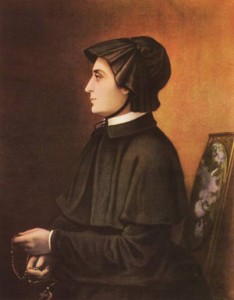
St. Elizabeth Ann Seton, ora pro nobis!

Today is the feast day of St. Elizabeth Ann Seton, who was canonized in 1975, making her the first American-born saint. Born in New York in 1774, Elizabeth was raised Episcopalian but was received into full communion with the Catholic Church in 1805, two years after her husband's death. To support her five children, Elizabeth opened a school in Baltimore and followed a religious life with other women. In 1809, she took official vows as a religious sister and founded the Sisters of Charity in 1809.

St. Elizabeth led an inspirational life of following Christ and she helped others to do the same. Her simple rule of life was summed up in three steps that she proposed to her religious sisters: "The first end I propose in our daily work is to do the will of God; secondly, to do it in the manner he wills it; and thirdly, to do it because it is his will." 

St. Elizabeth Ann Seton, educator and servant of the poor, pray for us!

Monday, December 26, 2011

Family life: A vehicle for God's grace

Today, on the Feast of St. Stephen - the first deacon and the first martyr for the Christian faith - I'll pass up the opportunity to write about the diaconate or martyrdom. Heady and important topics both, I'll concede, but I have been consumed lately with a draw to reflect on the blessings of family, on the vocation of marriage and on the graces that God provides in the still-small recesses of our homes.

Many of you are or will be called by God to the vocation of marriage and family life. But nearly all of us have families - even if only extended ones. And during the holidays, most of us are spending more time with our families than we have been accustomed to for some time.

Perhaps it's the Christmas season, with its inherent sentimentality; or maybe it is the reflective nature of the reality that yet another year is quickly drawing to a close, but whatever it is that seems to be drawing me in to prayerful reflections on these beautiful but often hidden spiritual truths about family, I am grateful because it has led me to some profound readings and reflections on the goodness and holiness of family life. One such reflection is found in the writings of St. Josemaria Escriva, the founder of Opus Dei. One of his published homilies is entitled: "Marriage: A Christian Vocation." His words, which are very appropriate during this Octave of Christmas, read, in part:


At Christmas our thoughts turn to the different events and circumstances surrounding the birth of the Son of God. As we contemplate the stable in Bethlehem or the home of the holy family in Nazareth, Mary, Joseph and the child Jesus occupy a special place in our hearts. What does the simple, admirable life of the holy family tell us? What can we learn from it? 
I would like particularly to comment on one of the many considerations that we might make on this theme. As we read in holy Scripture, the birth of Jesus means the beginning of the fullness of time. It was the moment God chose to show the extent of his love for men, by giving us his own Son. And God's will is fulfilled in the simplest, most ordinary of circumstances: a woman who gives birth, a family, a home. The power of God and his splendour come to us through a human reality to which they are joined. Since that moment Christians have known that, with God's grace, they can and should sanctify everything that is good in their human lives. There is no human situation, no matter how trivial and ordinary it may seem, which cannot be a meeting-place with Christ and a step forward on our journey toward the kingdom of heaven. 
It is only natural that the Church rejoices as it contemplates the modest home of Jesus, Mary and Joseph. We read in the hymn from matins on the feast of the Holy Family: 'It is pleasing to recall the lowly house at Nazareth and its slender resources, it is pleasing to tell again in song Jesus' hidden life. Jesus grows up in hidden seclusion, to be trained in Joseph's lowly trade. The loving Mother sits beside her dear Son, the good wife by her husband, content if her loving attention can ease and comfort them in their weariness.' 
When I think of Christian homes, I like to imagine them as being full of the light and joy that were in the home of the holy family. The message of Christmas is heard in all its forcefulness: 'Glory to God in the highest, and on earth peace to men of good will.' 'And may the peace of Christ triumph in your hearts,' writes the Apostle. It is a peace that comes from knowing that our Father God loves us, and that we are made one with Christ. It results from being under the protection of the Virgin, our Lady, and assisted by St Joseph. This is the great light that illuminates our lives. In the midst of difficulties and of our own personal failings, it encourages us to keep up our effort. Every Christian home should be a place of peace and serenity. In spite of the small frustrations of daily life, an atmosphere of profound and sincere affection should reign there together with a deep-rooted calm, which is the result of authentic faith that is put into practice.

During these days of the Christmas season, most of us are blessed to be able to spend a little more time with our families. See this time for what it is: a blessing. Sometimes that can be a difficult task. But God asks us to look not for reasons to complain, but for reasons to praise and to number our blessings, not our difficulties.

Find those reasons. Count your blessings and praise and thank God for all of them - especially for your families. Remember always that the family is the oldest of human institutions and is God's most basic building-block for the building up of his Kingdom. Furthermore, as Bl. John Paul II taught, the family is a "school of love." Learn to love in your family. If necessary, love to learn your family.

Finally, I'll leave you today with a prayer for families by Bl. Theresa of Calcutta:


Heavenly Father,
you have given us the model of life
in the Holy Family of Nazareth.
Help us, O Loving Father,
to make our family another Nazareth
where love, peace and joy reign.
May it be deeply contemplative,
intensely eucharistic,
revived with joy.


Help us to stay together in joy
and sorrow in family prayer.
Teach us to see Jesus in the members of our families,
especially in their distressing disguise.
May the eucharistic heart of Jesus 
make our hearts humble like his
and help us to carry out our family duties
in a holy way.
May we love one another
as God loves each one of us,
more and more each day,
and forgive each other's faults
as you forgive our sins.
Help us, O Loving Father,
to take whatever you give
and give whatever you take with a big smile.


Immaculate Heart of Mary,
cause of our joy, pray for us.


St. Joseph, pray for us.


Holy Guardian Angels,
be always with us,
guide and protect us.


Amen. 

Tuesday, December 20, 2011

Saints of the States

Bl. Kateri Tekakwitha
A 17th-century Native American woman who cared for the sick and elderly, and a Catholic nun who worked with lepers in Hawaii, are on the verge of becoming the newest American saints, after Pope Benedict XVI certified miracles due to their intercession, the Vatican announced Monday (Dec 19).


Here's an inspiring tale concerning Blessed Kateri's latest miracle:

Kateri's supporters submitted evidence of miracles but believed Kateri's chances of sainthood died with Pope John Paul, who bestowed sainthood on more people than all other popes combined.
Jake Finkbonner with his mother in front of a statue of Bl. Kateri
Then, in 2006, a 6-year-old boy cut his lip during a basketball game in Washington state.
Overnight, Jake Finkbonner's face swelled up and he developed a high fever, according to an NPR report. Doctors at Seattle Children's Hospital said a flesh-eating bacterium called Strep A was attacking the boy's face. Over the next few weeks, it destroyed his lips, cheeks and forehead. Doctors told the family the boy was going to die.
The family's priest asked his congregation to pray to Kateri on Jake's behalf. The priest chose Kateri because of her facial scars and Indian heritage – Jake is half Lummi Indian.
The prayers started coming in from around the world, and a representative from the Society of the Blessed Kateri went to the hospital to place a pendant of Kateri on the boy's pillow. The next day, the infection stopped progressing and Jake recovered.
Investigators from the Vatican researched the incident for three years, and on Monday, Pope Benedict approved it as a miracle attributed to Kateri's intervention.

Wednesday, December 14, 2011

The Dark Night Returns

St. John of the Cross
Today is the Feast of St. John of the Cross (Juan de la Cruz). His works are some of the most introspective and painstakingly honest works in all of Western Christianity. His most notable work is "The Dark Night of the Soul". It is both poem and spiritual instruction.

"Into this dark night souls begin to enter when God draws them forth from the state of beginners—which is the state of those that meditate on the spiritual road—and begins to set them in the state of progressives—which is that of those who are already contemplatives—to the end that, after passing through it, they may arrive at the state of the perfect, which is that of the Divine union of the soul with God. Wherefore, to the end that we may the better understand and explain what night is this through which the soul passes, and for what cause God sets it therein..." 
(Chapter 1 of "The Dark Night of the Soul")

Tuesday, December 13, 2011

Pie-ty

Some Catholic feast days have food associated with it. Sometimes the food goes a tad overboard on the symbolism. Behold! St. Lucy pastries! The only dessert you  can have a staring contest with!
St. Lucy Pie makes me want to say "OMM NOM NOM NOM NOM!"


It's like someone let Grant Morrison in the kitchen!

More traditionally are the "Lucy Cats" which are made in Sweden. They are, as the internet and some liturgical Advent materials say, delivered by young girls with candles in their hair on this day. The cakes, visibly (haha! pun!), are made in the image of eyeballs.


Lucy cats (as opposed to LOL CATZ)


 You think this is bad? Wait til you see what people do for St. Agatha's Day!

Monday, December 12, 2011

"Am I not here, who is your mother?"

On November 8, 1519 - only two years after the start of the Protestant Reformation in Western Europe - a Spanish conquistador named Hernando Cortes, led his army into the sprawling city of Tenochtitlan, the capital of the Aztec empire in modern-day Mexico. This was the symbolic start of the conquest of Meso-America by the Spanish.

The Spanish conquistadors were seeking fame and fortune. They were accompanied, however, by Catholic missionaries who were seeking to spread the Gospel of Jesus Christ to the indigeonous peoples of Meso-America. For more than a decade, the labor of the Catholic missionaries among the indigenous people was undertaken with few results. The vast majority of Meso-American Indians clung to the gods and customs of their old religion, spurning the efforts of the Catholic missionaries.

That all changed in 1531.

In that year on December 9 (the day on which the Immaculate Conception was celebrated within the Spanish Empire at that time), according to tradition, an indigenous peasant who had accepted Christianity had a miraculous vision of a beautiful young woman. The man's Christian name was Juan Diego and the vision took place on a hill called Tepeyac, in the desert just outside of Tenochtitlan (present-day Mexico City).

The lady who appeared to Juan Diego was dark-skinned and spoke in the native tongue of the local Indians and she asked Juan Diego to build a church on the spot where he was standing. She identified herself as "Mary, the ever Virgin Mother of the true God." Over the next few days, she appeared four times to Juan Diego, persisting to ask that the bishop build a church on top of the hill. Juan Diego was to be her messenger to the bishop, but the bishop refused to listen to him unless he was given some sign from heaven. Finally, on December 12th, Mary granted them a sign by causing roses to appear at the sight, which she instructed Juan Diego to gather in his tilma, and take to the bishop. The tilma that Juan Diego wore was a traditional outer garment worn by Meso-American men at the time. It was rough-hewn, made of agave (cactus) fibers, and it served as both a cloak and as an apron, useful for carrying items.

At Mary's insistence, Juan Diego gathered the roses from on top of the hill and took them to the bishop's palace in the city, thinking that the roses (miraculously blooming in December) were the sign the bishop would need to heed her requests for a church to be built. Upon reaching the chambers of the bishop and unfurling his tilma, however, the bishop responded not to the roses, but to the tilma itself which had miraculously come to bear a colorful image of Our Lady - an image of Mary that we now know as "Our Lady of Guadalupe."

The rest, as they say, is history. A small chapel was built on top of the hill to house the miraculous image of Our Lady on Juan Diego's tilma and, with almost immediate effect, the indigenous peoples who had spurned the missionaries for more than a decade began to accept the Gospel of Christ. Within a few short years, there was a flood of indigenous Christian converts entering the Church. It was truly miraculous.

At the time of the apparition, there was no Mexico. Much later (in the early 19th century), Our Lady of Guadalupe was adopted by those who initiated calls for Mexican independence from Spanish rule. But the importance of Our Lady of Guadalupe reaches far beyond any particular culture or group of people. She appeared to Juan Diego more than three centuries before her appearance to Bernadette in Lourdes, France and long before her appearance to the three shepherd children in Fatima, Portugal in 1917. Her appearance to Juan Diego was a clarion call which firmly established the Catholic faith in the Americas, so she belongs to all Americans - from Greenland to Chile. She is rightly called the Patroness of the Americas. In fact, in 1946, Pope Pius XII gave her this exact title.

She is also the Patroness of the Unborn. In the image, Our Lady appears with a black sash tied around her waist  - a traditional sign of being with child in pre-hispanic, Meso-American culture. In other words, the image of Our Lady of Guadalupe is one of the earliest-known depictions of Mary pregnant with her Divine Son. This is why Our Lady of Guadalupe has become an important symbol of the Pro-life movement.

So, today, celebrate the miraculous appearance of Our Lady here in the Americas. Throughout the centuries, she calls to all of us in the Americas to turn towards her Son and to live the Gospel. As she told St. Juan Diego so many years ago, she still gives us her "...love, compassion, help, and protection, because [she is] the merciful mother ... to all the inhabitants of this land."

Thursday, December 8, 2011

Mary Immaculate, pray for us!


Today, we celebrate the Immaculate Conception. On this day, we recognize that Mary was conceived in her mother's womb without the stain of original sin - a singular grace from God, through the merits of Christ Jesus.

Under the title "Immaculate Conception," Mary is the patroness of the United States. So, today is an especially good day to pray for our country and for our men and women in uniform. Ask for Mary's prayers for our country - God knows we need them!

For us Catholics in the United States, it is a Holy Day of Obligation (or should I say opportunity!... YEAH!), so make sure and attend Holy Mass. At St. John's here in Oxford, Masses will be at 12:10pm and 5:30pm. Don't forget!

O Mary, conceived without sin, pray for us who have recourse to thee.

Wednesday, December 7, 2011

Recent "saint"ly news

Bl. Marianne Cope (d. 1918)
It seems that one American "blessed" may have just taken the final step toward sainthood.

Yesterday, Vatican officials announced the findings of an independent medical board, who declared that there is no medical or scientific explanation for a recent miracle attributed to Blessed Marianne Cope. They have recommended that Pope Benedict name Bl. Marianne a saint.

It would be up to Pope Benedict to follow the recommendation of the Congregation for the Causes for Saints and to officially add Bl. Marianne to the list of the Church's saints. After that, she would officially be called "Saint" Marianne Cope.

Bl. Marianne Cope was a Franciscan sister who was born in Germany but raised in Utica, New York. In 1862, she entered the Sisters of St. Francis in Syracuse, New York. As a religious sister in New York, she helped to establish two Catholic hospitals in that state. She is best known, however, for her service to leprosy patients in Hawaii during the late 19th and early 20th century. In 1883, she responded to a plea for assistance and volunteered to move to Hawaii to serve. There, she succeeded Father Damien (now St. Damien), a Belgian-born priest also renowned for his ministry to those suffering from leprosy.

St. Ambrose: Now that's how you get a bishop!

St. Ambrose with that bishop gangsta lean
True story about today's saint:
"[About ]374AD, heresies threatened to destroy the Church. The bishop had supported the Arian heresy that argued against the divinity of Christ. Who would take his place - an Arian or a Catholic? Both sides met in the cathedral and a riot broke out.

Public order was Ambrose's responsibility as governor so he hurried to the church and made a passionate speech not in favor of either side, but in favor of peace. He begged the people to make their choice without fighting, using restraint and moderation.

Suddenly, while he was speaking, a voice called out, "Ambrose for bishop!" Soon everyone was shouting, "Ambrose for bishop!"...Ambrose ran away.

[After being discovered in a hiding place], Ambrose gave in. Since he'd been forced to take the position, no one would have been surprised if he'd decided to keep on living the way that he had before ordination. Instead, Ambrose immediately gave his property to the poor and put himself under the instruction of Saint Simplician to learn Scripture and theology." Notably, Ambrose was a catechumen at the time of his study and not baptized as a Christian!

And as bishop, he was notably concerned for the poor:
He wrote, "God created the universe in such a manner that all in common might derive their food from it, and that the earth should also be a property common to all. Why do you reject one who has the same rights over nature as you? It is not from your own goods that you give to the beggar; it is a portion of his own that you are restoring to him. The earth belongs to all. So you are paying back a debt and think you are making a gift to which you are not bound."

And for those who think a bishop can be EITHER concerned for the poor or faithful to the Church:
"We know from St. Augustine (Confess., IX, vii) and Paulinus the Deacon (Vita S. Ambros., § 13) that St. Ambrose introduced innovations, not indeed into the Mass, but into what would seem to be the Divine Office. St. Ambrose filled the church with Catholics and kept them there night and day until the peril [of Arian attack] was past. And he arranged Psalms and hymns for them to sing, as St. Augustine says, "secundum morem orientalium partium ne populus mæroris tædio contabesceret" (after the manner of the Orientals, lest the people should languish in cheerless monotony)..."


A man of the people and for the poor who cares for Catholic identity and promotes the liturgy? AMBROSE FOR BISHOP! AMBROSE FOR BISHOP!

Information compiled from the internet. Because it's all true online, kids!

Tuesday, December 6, 2011

Would the real St. Nicholas please stand up?

Today we get to celebrate the icon of American childhood: Santa Claus. The real Santa Claus.

There are few Catholic traditions more pervasive throughout all of American culture than the man in red. In the past century, he has become a well-known symbol of the Christmas season and you'd be hard-pressed to find someone (no matter what their religious persuasions) who couldn't identify Santa.

We know all about him, right? He lives at the North Pole. He wears a red, furry suit. He hangs out with elves and rides a flying sleigh pulled by reindeer. And - most importantly - he sneaks into people's homes during the night before Christmas, and delivers presents. That last part is a little creepy when you really think about it... but I digress.


So who is the real Santa Claus? Well, truth is, the idea of Santa is based on a man who lived many centuries ago and wasn't all gingerbread and sugar plums. Instead, it seems that he was one tough cookie with a soft heart for the poor. His dress? Almost certainly not a red, fur-trimed suit. Instead, he wore the normal dress of fourth century men of his region - a tunical or a casula. And his home? Far from roaming reindeer or the snow of the North Pole - it was a town on the Mediterranean coast in modern-day Turkey. One thing that might be familiar: he probably did have a beard. His name was Nicholas.

As with most early saints, we don't know a whole lot about Nicholas. He was likely born around the year 270 in the city of Patara in Asia Minor (modern-day Turkey). Stories that have been preserved throughout the centuries, tell of a man who took his Catholic faith very seriously. Tradition records that Nicholas was the only child of wealthy parents. His parents died when he was a child - victims of an epidemic in the region, and Nicholas was raised by a devout uncle (also named Nicholas) who led the young man to be very active in the Church from an early age.

By the first decades of the fourth century, Nicholas was the bishop of Myra (now known as Demre), on the Mediterranean coast of Turkey. He led his local congregation through difficult years of the Diocletian Persecution - the most widespread and deadliest of the Roman persecutions against the Church. In 325, Nicholas participated at the Council of Nicaea - the first ecumenical (i.e. worldwide) council of the Church's bishops. There, Nicholas was numbered among the bishops, priests and deacons (including many who had been maimed during the last persecution), in a meeting called by the Roman Emperor Constantine to address the Arian teachings which were spreading through the Church at the time.

Arius was a priest in the city of Alexandria, Egypt - an important city for the Church at that time. He taught that God the Father existed before, and was superior to, the Son. This was not "the faith once delivered to the saints" and passed down from the Apostles (Jude 1:3). It was a novelty, but a popular one which was quickly spreading throughout the Roman Empire and sewing division in the Church. Constantine called the Church's bishops to Nicaea to make a formal decision on the teachings of Arius.

One story records that Arius stood in front of the assembled bishops and the emperor himself, and explained his teaching that Christ was homoiousious (of a similar nature) instead of homoousious (of the same nature) as God the Father. As he explained his position, one bishop - Nicholas - stood up, calmly walked over to Arius and slapped him across the face in front of everyone.

Nicholas lays the smack down on Arius at the Council of Nicaea.
Yes, Nicholas took his faith very seriously.

Another well-known story about Nicholas tells of how, while he was Bishop of Myra, he heard about a poor widower in the town who had three daughters for whom he could not afford to pay a dowry. This, of course, meant that they would not be married and, in that time and culture, had a very uncertain future. Nicholas took it upon himself to remedy this situation in a clever way that would preserve Nicholas' modesty and would protect the man from the humiliation of having to receive charity. In the dark of night, Nicholas tossed three pouches of gold coins into the open window of the man's home and then snuck away in the darkness. The coins were just enough to pay the dowry for each of the man's daughters. The man caught up with Nicholas and thanked him, but Nicholas modestly told the man to thank God alone and asked him not to tell others about his act of anonymous generosity. (By the way - if you've ever noticed the symbol of the three gold balls that many pawn shops use, it comes from this story - St. Nicholas is the patron saint of pawn brokers). 

From this story, it is easy to see how St. Nicholas became associated with gift-giving. In fact, it is on the night before this day (not the night of December 24th) when many children in Europe receive gifts "from St. Nicholas." Here in the United States, the Dutch version of St. Nicholas, Sint Nicolaas, and its abbreviated form, Sinterklaas, became corrupted into the now familiar Santa Claus. Clement C. Moore's famous poem, A Visit From St. Nicholas (you know: "T'was the night before Christmas..."), first published in 1823, went a long way to spread the popularity (and form the American version) of a jolly man who visits children during the Christmas season, bringing them gifts. You can also thank some great illustrations and advertising from the 19th and 20th centuries, which have cemented our American ideas about who Santa Claus is and what he looks like.

Interestingly, we may have a really good idea about what the real St. Nicholas looked like. In 2005, the remains of St. Nicholas - which had been "translated" (i.e. moved) from his original tomb in Myra to Bari, Italy in 1087, after the Muslim Turks took over control of Myra - revealed that he stood barely 5 feet tall and, at one point, had suffered a broken nose. Based on the measurements of his bones, forensic scientists created a computer-generated image of what St. Nicholas might have looked like. (see below)

In any case, on a day like today, it's best to celebrate this great saint of the Church by emulating his actions. Do something nice for someone, anonymously. Help someone in need, anonymously. Do it for the glory of God and the good of your soul. And be like St. Nick!

Forensic reconstruction of St. Nicholas, based on his skull.