Pages

Showing posts with label Cool Catholic Traditions. Show all posts

Friday, February 3, 2012

Cool Catholic traditions: Blessing of the Throats

A priest blesses parishioners' throats on the Feast of St. Blaise

Today, many Catholics carry on a very old (and very cool) tradition: the blessing of the throats. Today is the Feast Day of St. Blaise and for centuries, on this day, Catholics have had a custom of blessing throats, asking for God to preserve our throats from illness. 

How does the "blessing of the throats" work? 
Candles to be used during the blessing.

Well, here's how it goes down: During the blessing (which usually takes place either before or after the daily Mass), the priest holds two candles tied together with a red ribbon in the form of a cross at the throat of the person seeking a blessing and prays aloud: "Through the intersession of St. Blaise, bishop and martyr, may God preserve you from throat troubles and every other evil. In the Name of the Father, and of the Son, and of the Holy Spirit. Amen."


Beyond that - as with any prayer - the mechanics and the effectiveness are matters of faith, and are up to God alone. 


Who was St. Blaise and how did blessing throats become associated with his feast day?

Statue of St. Blaise.
St. Blaise was a physician who became the bishop of a city called Sabastea in what is now Turkey in the latter part of the third century. He died as a martyr for the faith in AD 316 and from soon after his death, he was hailed and venerated as a saint. 

Few details are known about St. Blaise. According to tradition, he lived a life of prayer and fasting in a cave just outside of Sabastea. It is said that he healed injured animals and that the sincerity of his faith served as a great inspiration for all who knew him.

One very old story about this holy bishop was that, through his intercession, God miraculously healed a young boy who had a fish bone stuck in his throat. For this reason, the prayers of St. Blaise have long been invoked for those threatened by or suffering from injuries and illnesses of the throat.

Remember: Catholic traditions such as the blessing of the throats are venerable and are a wonderful part of our faith. But they aren't acts of superstition. We should approach this and all "cool Catholic traditions" as an important part of our Catholic patrimony (something that we have inherited and must pass on) that draws us prayerfully closer to our Lord and to his Church.

Happy St. Blaise's Day!

Sunday, January 15, 2012

From the "cool Catholic stuff" file...

The Catholic cathedral of St. Joseph in Buffalo, New York, recently discovered a long-lost piece of its own history, tucked away in the corner of the building's sacristy. A rare tapestry - apparently a gift from Pope Pius IX (d. 1878) to the diocese's first bishop, Bishop John Timon (d. 1867).


The design of the tapestry displays the feasts on the Church calendar (as it stood in the 1860s) for all 365 days of the year. For each feast day, a relic is sewn into the fabric. Relics of hundreds of saints are joined to the tapestry and, in the center is a relic of the True Cross - a tiny sliver of wood from what it believed to be the Cross of Christ. The relic of the True Cross is surrounded by the Latin words: "In hoc, vinces" (In this, conquer) - an ancient motto connected with Constantine, the first Christian Roman Emperor.

You can read the full article from the Buffalo News about the historic find here. Just an all around cool Catholic story. FWIW, the reliquary/tapestry is now hanging prominently in the cathedral's sacristy.

Saturday, January 14, 2012

Catholic chic: Saints for Sinners... groupon!


I've written before about Saints for Sinners - the eye-catching medals straight from the heart of New Orleans. If you don't own one of their hand-painted medals, you should. And for a limited time, they have a groupon which allows you to buy two medals for the price of one. Great deal.

Do I get anything for this shameless product plug? No.

But I'm always willing to get the word out on ways that we can reclaim our Catholic identity. Wearing a saint medal or a Miraculous Medal is one definitive way to do just that. Plus, they're just cool.

I've bought these medals both online and in New Orleans and can vouch for the superb customer service and quality product that Rob provides. Just wanted to pass on to all our readers, the fact that with the groupon, you can get a great deal on a great medal. Good stuff all around.

Happy Festum Asinorum!

The Venerable Ass
Today on the medieval calendar, Churches celebrated "THE FEAST OF THE ASS".This politically incorrect tale tells us more:

The 'Festival of the Ass,' and other religious burlesques of a similar description, derive their origin from Constantinople; being instituted by the Patriarch Theophylact, with the design of weaning the people's minds from pagan ceremonies, particularly the Bacchanalian and calendary observances, by the substitution of Christian spectacles, partaking of a similar spirit of licentiousness,—a principle of accommodation to the manners and prejudices of an ignorant people, which led to a still further adoption of rites, more or less imitated from the pagans. According to the pagan mythology, an ass, by its braying, saved Vesta from brutal violence, and, in consequence, ' the coronation of the ass ' formed a part of the ceremonial feast of the chaste goddess.


An elaborate sculpture, representing a kneeling ass, in the church of St. Anthony at Padua, is said to commemorate a miracle that once took place in that city. It appears that one morning, as St. Anthony was carrying the sacrament to a dying person, some profane Jews refused to kneel as the sacred vessels were borne past them. But they were soon rebuked and put to contrition and shame, by seeing a pious ass kneel devoutly in honour of the host. The Jews, converted by this miracle, caused the sculpture to be erected in the church. It takes but little to make a miracle.
http://www.thebookofdays.com/months/jan/14.htm

There also was a corruption of the liturgy on this feast day that went like this:
 
Mass was continued, and at its end, apparently without awakening the least consciousness of its impropriety, the following direction (in Latin) was observed: In fine Missae sacerdos, versus ad populum, vice 'Ite, Missa est', ter hinhannabit: populus vero, vice 'Deo Gratias', ter respondebit, 'Hinham, hinham, hinham.'(At the end of Mass, the priest, having turned to the people, in lieu of saying the 'Ite missa est', will bray thrice; the people instead of replying 'Deo Gratias' say, 'Hinham, hinham, hinham.')*


The more things change...

I made up some downloadable Feast Day cards for all of you to print up and, maybe this Sunday, pass on to your Ass at Mass (rhymes!)!
Front
Back
*hinham must mean "hee haw" in Latin. Still sounds funny.

Thursday, January 12, 2012

What the heck is a cardinal, anyway?


Apart from the newly-crowned national football champions (Go SEC!), there's been another tide of crimson on the horizon in the news: 

Earlier this week, Pope Benedict announced a consistory in which he will raise 22 prelates to the Sacred College of Cardinals. Among the newly named cardinals are two Americans: Timothy Dolan, the current archbishop of New York and Archbishop Edwin O’Brien, the former archbishop of Baltimore and the current Grand Master of the Equestrian Order of the Holy Sepulchre of Jerusalem.

I was gonna post that news and leave it at that. But it occurred to me that for most of us, that one paragraph is packed with lots of terms that could use unraveling and defining. In fact this one news item is replete with enough high technical Catholic speak to make a layperson’s head spin… not to mention what it must do to our gracious non-Catholic readers. So let’s play an educational game that I like to call, “What the heck does all of that mean?!?”


Let’s get started:

“Earlier this week…”

Okay. I assume we’ve all got that one. Moving on.

“…Pope Benedict…”

You know – the Holy Father; the Successor of St. Peter and the Vicar of Christ, and all that.

“…announced a consistory…”

Okay. The key term here is “consistory.” What is a consistory? Basically, it’s a fancy word for a meeting of the Church’s cardinals. Each time the cardinals meet officially, it’s called a consistory. There is one exception: when the cardinals meet to elect the new pope, that meeting is called conclave. Let’s keep going.

“…in which he will raise 22 prelates to the Sacred College of Cardinals.”

Now it’s getting fun. First of all, what are “prelates?” The term “prelate” is just a fancy word that can be used to describe Church leaders (especially bishops). And now, a really important term: “Sacred College of Cardinals.”

“Sacred College” is a schmoozey synonym for “group,” and it’s simply the official name of the collective group of cardinals of the Church.

“So, what’s a cardinal?” you ask. Well, basically, a cardinal is an official in the Church who has two important responsibilities.

Firstly, cardinals help the Pope in his role of governing the Church. You have to remember that the Church is big… really big. In fact, it’s huge. Somewhere close to 1.2 billion of the world’s population is Catholic.

So to better serve the members of the Church throughout the world, the Church has developed (throughout the centuries) a series of departments (called by the Italian word dicasteries) that help to govern certain aspects of daily Church life. Examples of dicasteries are the Secretariat of State (remember the Vatican is not just the spiritual headquarters of the Church, it is also a City-State), and “congregations” which help to govern aspects of Christian life such as the Congregation for Bishops, Congregation for Divine Worship and the Discipline of the Sacraments. Each of these dicasteries is headed by a cardinal.

So, in that regard, you could say that cardinals serve a similar role in service to the Pope as cabinet members do for a U.S. President. They advise the Holy Father and help to run the day-to-day operations of the Church.

Secondly, cardinals are the ones responsible for electing a new pope whenever the seat of Peter becomes vacant (by death or resignation). That’s a pretty heavy call. When a pope dies, the cardinals meet together in conclave. Only cardinals who are 80 years old or younger at the start of the Conclave, may have a vote in electing the next pope.

Historically, the term “cardinal” comes from the Latin word cardo, referring to a door hinge. In the medieval Church, the title referred to the priests who were assigned to ancient and important parish churches (called “titular parishes”) around Rome – assignments which came with important duties as these “incardinated” priests acted as a sort of “priestly council” in aiding the Bishop of Rome (i.e. the Pope) in his ministry to the city of Rome and to the wider Church. By the twelfth century, popes began to appoint priests and bishops from outside of Rome as cardinals. These extra-Roman cardinals would be assigned as the symbolic pastors of the old titular parishes in Rome and the surrounding areas. Interestingly, this tradition still exists as each modern cardinal is still assigned a titular church. This is all little more than symbolic nowadays as each of the titular churches has its own actual pastors and staff – but it is a beautiful connection to the past.

“Among the newly named cardinals are two Americans: Timothy Dolan, the current archbishop of New York…”

Cardinals are traditionally chosen from among the ordinaries (i.e. bishops or archbishops) of large and/or important dioceses and archdiocese from throughout the world. These men bring with them valuable experience in Church government and a real connection to (and hopefully a real understanding of) their local flock and the challenges that the Church faces in their own little corner of the globe. This is invaluable in the cardinals’ role as advisors to the Holy Father. While some cardinals move to Rome to carry out their new duties and responsibilities, most, remain in their home see (i.e. diocese) and go to Rome only when official business (or an impending conclave) warrants. This explains why Archbishop Dolan, for example, will continue to serve as the archbishop of New York. He just now has a fancier title (Cardinal Dolan) and more responsibilities.

“…and Archbishop Edwin O’Brien, the former archbishop of Baltimore and the current Grand Master of the Equestrian Order of the Holy Sepulchre of Jerusalem.”

Archbishop O’Brien, who is the retired archbishop of Baltimore, is an example of a soon-to-be cardinal who will live in Rome. Retired and no longer the ordinary (i.e. bishop) of his diocese, he is the Grand Master (i.e. leader – but “Grand Master” sounds much cooler) of the Equestrian Order of the Holy Sepulchre of Jerusalem, an order of Catholic knighthood which traces its origins all the way back to the First Crusade and its first recognition by the pope in 1113. So, with this paragraph, hopefully we’ve learned two things: that there are still Knights from the Crusader-era and their leader is a retired American archbishop. 

The new American cardinals will be among 22 which will be given the red hat in February. Oh – I probably didn’t mention that one other perk of being a cardinal is that you get to wear a lot of red (see below). Currently, there are 192 members of the College of Cardinals. 17 of those are from the U.S.


Sunday, January 8, 2012

La Befana: Christmas Witch

I was doing a bit of reading on Epiphany customs and ran across the custom in Italy known as "La Befana". The legend goes that a woman, Befana (short for "epiphany") was invited by the Magi to go see the Christ-child. She refused to go but later regretted it so now she travels around the world seeking the baby and doing favors for children on the eve of Epiphany. And she travels on a broom!
La Befana, the action figure!

More here. and here.

And if you like your witches a little cuter, then check out this video from a Bella Befana!

Friday, January 6, 2012

Happy Epiphany! ...sort of


Today is January 6. Which means that it has been twelve days since Christmas. Simple math, really. Why does that matter. Well, today is the “Twelfth Day of Christmas” (you know the song – partridge in a pear tree and all). But beyond an 18th century Christmas carol, there are important historical links between today (January 6) and Christmas.

Epiphany and Christmas – what’s the connection?

Let’s go back to square one. First of all, nobody (that we know of) thought to write down Jesus’ birthday.  Believe it or not, things like exact birthdays just weren’t that important in the first century and weren’t written down. In the third and fourth centuries, however, there was a clamoring to add a celebration of Christ’s birth to the Church calendar. At that point, the main feasts of the Church were Easter, followed by (in order of solemnity) Pentecost and the Ascension. There was also already a long-standing tradition of saints’ days (marking the “heavenly birthdays” of martyred believers).

Birthday of the sun or birthday of the Son?

Sometime during the late third century, local churches began to add a commemoration of Christ’s birth to their local calendars. In the West, December 25 was added to the calendar as the Feast of the Nativity of Christ. Some have speculated that this date was chosen to coincide with the Winter Solstice which was, at that time, celebrated on December 25 and which pagan Romans viewed as the “birthday of the sun” (– get it? Christians one-upped them by setting the same day as the birthday of the true Sun of Righteousness, cf. Malachi 4:2), but this notion is a somewhat recent one.

A more interesting (and ancient) theory

In recent years, many scholars have revived a very ancient argument that the date of December 25 was actually chosen precisely because it fell nine months after March 25. Here’s how it worked: Many early Church Fathers considered that Jesus was crucified on the 14th day of the Jewish Lunar month, Nisan (as the Gospel of John records). This date was the equivalent of March 25 on the Roman (solar) calendar. Great figures in Roman antiquity were assumed to have lived “complete years.” In other words, the day that they died was assumed to have been the exact day that they entered into the world, however many years earlier. If Jesus died on March 25 on the Roman calendar, these Church Fathers assumed that he entered into the world on March 25, some 33 years earlier. And when did he enter into the world? At the Annunciation, where Mary gave her fiat, and Christ was conceived in her womb; and nine months later, on December 25, he would have been born.

And in the East...

At any rate, and regardless of the reason, during the early fourth century, the Christian West began to observe December 25 as the feast of Christ’s Nativity. But a different date arose in the Churches of the Eastern part of the Empire. In the Christian East, around the same time, Churches adopted January 6 as the date of a feast day which commemorated all of the mysteries of Christ, up to the time of his public ministry: his birth in Bethlehem, the visit of the Magi, his Baptism in the Jordan and his first miracle at the Wedding at Cana. These were all celebrated as “epiphanoi”, or “manifestations” of Christ’s divinity.

It seems that the Eastern Churches, too, in settling on January 6 as their day of Epiphany, did so by calculations based (in the same way as the West), on the date of Christ’s crucifixion. 14 Nisan on the Jewish calendar corresponds to April 6 on the local Greek calendars in the Roman east. Thus, following the same logic as was mentioned above, making January 6 (in their reckoning) the correct day of Christ’s birth.

Coming together

Eventually, over time, the Christian West and the Christian East began to recognize one another’s feasts and by the late fourth century, December 25 was imported onto Eastern Christian calendars as a separate feast of Christ’s Nativity while January 6 found a place on Western calendars as Epiphany. The emphasis in the West has on Epiphany has long been on the visit of the Gentile Magi as a “manifestation” of Christ’s divinity mission to save all of the world. In the Christian East, today is known as Theophany, stressing the manifestation of Christ not only as messiah, but as God.

What happened to Christmastide?

Traditionally, Epiphany marks the end of the Christmas Season (also known as Christmastide). That is why it is said that there are twelve days of Christmas. The time between December 25 and January 6 was one of continuous feasting which had Twelfthnight (the night of January 5) as its climax in celebration. But I also have to point out that we won’t celebrate Epiphany in the Church (at least in our diocese) until this coming Sunday, January 8. The deep-seated tradition of the Twelve Days of Christmas in our culture was evidently not taken into account when the Catholic bishops in our country began moving the commemoration of Epiphany to the first Sunday after January 1. The Holy See approved this move in 1984. The move did away with Christmastide and makes that cheesy old carol completely nonsensical.

Laissez les bons temps reouler!

Regardless of Church-mandated movement, today is still important in parts of the Deep South where Carnival is celebrated. Twelfthnight is the official kickoff for the Carnival Season in New Orleans, Mobile and along the Mississippi Gulf Coast, where many of our friends will now begin a season of parades, balls and king cakes that ends on Mardi Gras (Fat Tuesday), the day before Ash Wednesday.

So, have a slice of king cake and have a wonderful Epiphany (I guess I can say that again this Sunday). So, laissez les bons temps rouler (let the good times roll!). 

My brush with Andre

Saint Andre Bessette
Today's (optional) Memorial is for Saint Andre Bessette. I was asked if I'd ever been to St. Joseph Basilica in Montreal which was built by Brother Andre in honor to St. Joseph. I replied, "That's out of town isn't it?"

However, a few years back, a parishioner brought me some oil from the Basilica. The bottle says:
"Brother Andre often advised those who came to him to rub themselves with some vegetable oil which had been burning in front of the statue of St. Joseph. Even today, oil used in this manner remains a link with our tradition. It is an expression of faith. It is not the oil itself which cures, but the Lord who hears the prayer of the faithful."

My Blessed Oil from Blessed Andre
Brother Andre was known to be a healer but never took credit for the "cure". He also understood that just as much as healing was good for the soul, sometimes enduring with pain or sickness was also a value.

On another occasion he said: "If the soul is sick, one must begin by treating the soul." His often repeated questions were well known: "Do you have faith? Do you believe that God can do something for you? Go confess yourself to the priest, go to communion and then come back to see me." These were the words he used constantly when asked for favors and cures.
Brother Andre understood the sense and the value of suffering and spoke with depth when addressing the subject. "People who suffer have something to offer to God. When they succeed in enduring their suffering, that is a daily miracle."
To someone who was suffering, he said: "Do not seek to have these trials lifted from you. Instead, ask for the grace to bear them well."
http://www.ewtn.com/library/mary/broandre.htm

Wednesday, January 4, 2012

Morning Offering

From my new Daily Roman Missal (which I highly recommend), a traditional prayer to start your day:

O Jesus, through the Immaculate Heart of Mary, I offer you my prayers, works, joys, and sufferings of this day for all the intentions of your Sacred Heart, in union with the holy sacrifice of the Mass throughout the world, in thanksgiving for your favors, in reparation for my sins, for the intentions of all my relatives and friends, and in particular for the intentions of the Holy Father. Amen.


Monday, January 2, 2012

What's in a name? ...or a symbol?


As we've mentioned before on this site, each month of the year is traditionally dedicated to a specific devotion. January is dedicated to the Holy Name of Jesus.

It's easy to see how early Christians came to attach a great spiritual value on the very name of our Lord. In his letter to the Philippians, after all, St. Paul writes: "...God greatly exalted him and bestowed on him the name which is above every name, that at the name of Jesus, every knee should bend ... and every tongue confess that Jesus Christ is Lord" (Phil 2:9-11).

Names are important. They are not simply labels for a person; they are a verbal image of the person. Jesus' name, especially, is sacred. Sacred Scripture is full of examples of how the name of our Lord is powerful and effective. It is more than appropriate to honor and revere his name, for it is holy.

It is long-standing custom to bow one's head whenever the name of Jesus is uttered. In fact, Catholics are specifically instructed to bow our heads at every mention of Jesus' name during the Mass (as well as at the names of the Holy Trinity, Our Lady and the Saint being celebrated in that particular Mass).

The General Instructions of the Roman Missal (GIRM) (which you can read online here) clearly states:

"A bow signifies reverence and honor shown to the persons themselves or to the signs that represent them. There are two kinds of bow: a bow of the head and a bow of the body. 
a) A bow of the head is made when the three Divine Persons are named together and at the names of Jesus, of the Blessed Virgin Mary, and of the Saint in whose honor Mass is being celebrated." (GIRM, No. 275)

St. Bernadine of Siena (d. 1444)
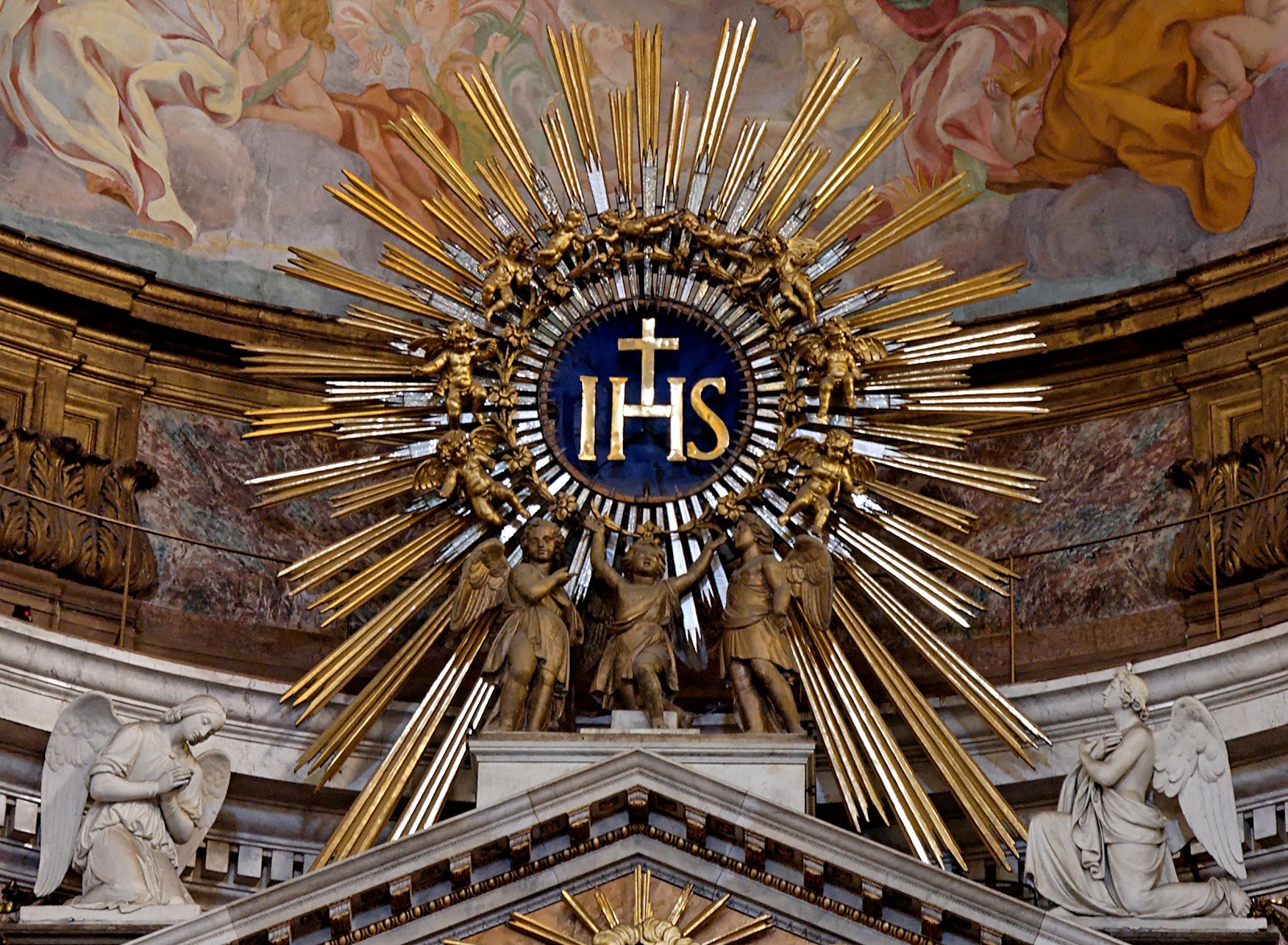
The feast of the Holy Name of Jesus, which we celebrate today, dates back to the fifteenth century. But long before this, there was a fervent devotion to the Holy Name. St. Bernard of Clairvaux (d. 1153) promoted devotion to the Holy Name as did the famed Franciscan preachers St. Bernadine of Siena (d. 1444) and St. John of Capistrano (d. 1456). Both Bernadine and John would preach missions in cities throughout Europe and carried with them wooden tablets painted with a monogram of the Holy Name, which they would encourage the faithful to venerate after their sermons. They also encouraged families to place a copy of the monogram of Jesus' name above the doors of their homes and above the gates in their cities. Many years later, the Society of Jesus (i.e. the Jesuits) adopted a version of the sacred monogram as the primary emblem for their society.

Today, it is common to see the monogram that Sts. Bernadine and John of Capistrano promoted used in Church artwork or as a decorative motif in churches and on sacred vestments. This monogram is comprised of three letters: IHS. These correspond to a Latinization of the first three letters in the Greek version of Jesus' name: IHSOYS (sometimes, it is written IHC, because C and S are interchangeable). So, this monogram is basically an abbreviation of Jesus' name.

There are other monograms associated with our Lord as well. Another well-known example is sometimes called the Christogram -  a symbol where the Greek letters Chi (X) and Rho (P) are interposed on one another. This symbol is known as the "Chi Rho" (real original, huh?), and it is an ancient abbreviation for the Greek title "Christos,"or Christ. Chi and Rho are the first two letters in the spelling of this word. The Chi Rho has been used by Christians since the early centuries of the Church and it was adopted by the Roman Emperor Constantine as a symbol of his Christian faith and a symbol of the Empire. He had his soldiers paint the Chi Rho on their shields before battle and used it on the coinage that he minted, as did other Roman Emperors during the fourth through seventh centuries.

My challenge to you today is to take on a brand new New Year's resolution: honor the name of Jesus. How can you do this? Well, here are three easy tips:

1) During Mass, bow your head each time Jesus' name is uttered. Yep - every time. As we pointed out above, this isn't just a pious custom, it is actually one of the instructions for the faithful during Mass. So, not only will you actually be following what the Church asks us to do, you will actually start to develop a sensitivity to the gravity and power of our Lord's holy name.

2) If you use the Lord's name in vain, stop. Whether it's used nonchalantly or even as a curse word, we are not to use the Lord's name in vain. Be deliberate with your use of the Holy Name. If you're in a bad habit of blaspheming by cussing with Jesus' name, ask for God's help to stop.

3) Work on coming to an internal reverence for Jesus' name - whenever and wherever it is spoken. Jesus name literally means "God saves." Think about that for a moment. God saves. Whenever we say the name of our Lord with reverence and begin to consciously honor his name, we reaffirm the divine truth that in Jesus, God saves. That's pretty powerful stuff. There was a time when Catholic men would remove their hats and all Catholics would bow there heads whenever Jesus' name was spoken - anywhere and everywhere. When his name was taken in vain, Catholics in the room would cross themselves and mutter a silent prayer ("Blessed be the name of the Lord!"). Pious actions such as these can influence our faith over time - and can influence the faith of others who witness them.

Finally, in honor of the Holy Name of Jesus, try praying the Litany of the Holy Name today.

So, what's in a name (or a symbol)? Power. Blessing. Truth.

Blessed be the name of the Lord! Now and forever!

Tuesday, December 27, 2011

Happy patronal feast day, St. John's!

Today is the feast day of St. John - the evangelist and the apostle. The only of the disciples who authored a Gospel (which is why we call him the evangelist, or "Gospel-writer"), St. John was also known as the disciple whom Jesus loved, and he is the one who Jesus chose to take Mary into his home after the crucifixion - another sure sign that our Lord held him in the highest regard. After the death and resurrection of Jesus, John seems to have traveled and preached the Gospel before finally settling in the city of Ephesus. He is, of course, the patron saint of our Catholic parish here in Oxford, Miss.

Symbols of St. John

There are two main symbols that have come, over the centuries, to be associated with St. John. One of the symbols is the eagle. In the Bible, the Prophet Ezekiel described a vision of heaven where, around God's throne, were seraphs with the faces of a man, a lion, an ox and and an eagle. Over time, each of the four Evangelists (Gospel writers) became associated with one of these four symbols: Matthew with a man, Mark with a lion, Luke with an ox and John with an eagle. It is said that John became associated with the eagle because his Gospel (especially in the prologue) is so theological in nature, soaring, as it were, towards heaven - like an eagle.

The other symbol of St. John is the chalice. This association with the Evangelist comes from John's presence at the Last Supper (he was the only Gospel-writer who was also a Disciple of Christ), and from Jesus' words to John and his brother James: "My chalice, indeed, you shall drink." (Matthew 20:23). Often, St. John's chalice is depicted with a serpent crawling out of it. This image comes from a story about St. John in his latter days. The story says that someone tried to kill John by offering him a poisoned chalice of wine. Before drinking, John made the sign of the cross in blessing over the chalice and, when he did so, the poison took the form of a serpent and slithered out of the chalice. John then drank the remaining wine, unharmed.

St. John's Love

Because of the story of the poisoned chalice, it has become a tradition for priests to bless bottles of wine on St. John's feast day (today). In fact, in our parish, we have the blessing of wine after the Mass, in honor of St. John. Wine that has been blessed on St. John's feast day is often called the "Love of St. John." This blessed wine may be used for special occasions throughout the year.

Here is a traditional way of drinking "Love of St. John" with your family and friends. It comes from fisheaters.com.


When it is drunk on his Feast Day, we drink it before dinner as a toast to St. John. The Father of the house lifts his glass toward Mother and says, "I drink you the love of St. John." The Mother replies "I thank you for the Love of St. John" and then turns to the oldest child, lifts her glass, and says, "I drink you the love of St. John..." -- and on it goes down the line until each has been toasted.
The wine may be drunk as is, out of the bottle, or may be prepared as in this recipe:
St. John's Love (serves 8)
1 quart red wine
3 whole cloves
1/16 teaspoon ground cardamom
2 two-inch cinnamon sticks
1/2 teaspoon ground nutmeg
1/2 cup sugar
Pour the wine into a large saucepan. Add the remaining ingredients. Boil for 5 minutes (this pretty much evaporates all of the alcohol). Serve hot, clinking glasses with the toast "Drink the love of St. John!" I suggest doing this in front of a roaring fire!

Saturday, December 24, 2011

12 Days of Christmas as Comics

12 Lords a Leaping. Get it?
More here.

For the more traditional take on the 12 Days (which are "codes" for the days between the Feast of the Nativity until Epiphany), check out this explanation:
“The Twelve Days of Christmas” celebrates the official Christmas season which starts liturgically on Christmas Day and ends twelve days later on the Feast of the Epiphany. “My true love” refers to God, “me” is the individual Catholic. The “twelve lords a leaping” are the twelve basic beliefs of the Catholic Church as outlined in the Apostles Creed. The “eleven pipers piping” are the eleven Apostles who remained faithful after the treachery of Judas. The “ten ladies dancing” are the Ten Commandments. The “nine drummers drumming” are the nine choirs of angels which in those days of class distinction were thought important. The “eight maids a milking” are the Eight Beatitudes. The “seven swans a swimming” are the Seven Sacraments. The “six geese a laying” are the Six Commandments of the Church or the six days of creation. The “five golden rings” are the first five books of the Old Testament called the Torah which are generally considered the most sacred and important of all the Old Testament. The “four calling birds” are the Four Gospels. The “three French hens” are the Three Persons in God or the three gifts of the Wise Men. The “two turtle doves” represent the two natures in Jesus: human and divine or the two Testaments, Old and New. The “partridge” is the piece de resistance, Jesus himself, and the “pear tree” is the Cross."

But the idea of Darth Vader leaping? Still cool.
 

Friday, December 23, 2011

El Caganer: A Lovely Spanish Creche Tradition

You gotta love off-the-wall holiday traditions. The Swedes have their day-long Donald Duck TV show marathon on Christmas Eve (no, seriously) and the Germans and Austrians have the Krampus. But one of the most unique just has to be el caganer of the traditional Spanish nativity scene.

"Merry Christmas! Sh*tter was full!" 
What is the caganer you might ask? Well, quite literally, it is a person... ummm... (how can I put this delicately? - Oh good, my nine-year-old son looking over my shoulder as I type this helped me out: "Just put it's a guy taking a poo.").

Fine then. It is a guy taking a poo. There ya go.

Yep, really. Merry Christmas, huh?

No Spanish creche is considered complete without the caganer. They say it first appeared in the Catalan region of Spain in the 17th century. There, the creche traditionally depicts a miniature of many buildings in Bethlehem (not just the stable/cave). There are also many villagers depicted going about their day-to-day activities (washings clothes in a stream, selling goods in a market, etc.) And somewhere, tucked away in the bustle, usually hidden discreetly, is the caganer, pants down and doing his business.

I know many of us would find it a bit distasteful, but it's a long-standing tradition in Spain and even in some areas of Portugal and Naples. It's traditional for children to try and find the caganer. The classic caganer is dressed in traditional Catalan folk attire, complete with a red barretina, but in some families, they've moved to having the caganer based on a modern celebrity (If you wonder what I'm talking about, just google "Barack Obama caganer.")

So, as you trudge through these last couple of days of holiday madness, just remember that it could be worse: you could be el caganer, bottom bared for the world to see, performing the one bodily function that could even despoil the serenity of the birth of our Savior. Maybe the lesson to take from this post is that you want to make the holidays as easy as you can for your family: don't complain, don't moan or whine - just be pleasant and helpful. Because, all in all, no one wants to be the caganer in the creche.

Wednesday, December 21, 2011

Solstice, man

Winter Solstice at Stonehenge. Wow, that's funny cuz it's "STONE" henge.
 Some of the hairy, dred-headed, white kids who work at the bakery or are working on their degree in advanced harmonics may wish you a "Happy Solstice" today. It's not "Merry Christmas" but close. Take this very long article from ask.com for example:
The time around December 21 or 22 is a very important day for our planet and its relationship with the sun. December 21 is one of two solstices, days when the rays of the sun directly strike one of the two tropical latitude lines. In 2011 at precisely 12:30 a.m. EST (05:30 UTC) on December 22, 2011 winter begins in the Northern Hemisphere and summer begins in the Southern Hemisphere.
The earth spins around its axis, an imaginary line going right through the planet between the north and south poles. The axis is tilted somewhat off the plane of the earth's revolution around the sun. The tilt of the axis is 23.5 degrees; thanks to this tilt, we enjoy the four seasons. For several months of the year, one half of the earth receives more direct rays of the sun than the other half.
The earth's axis always points to the same point in the universe. When the axis points away from the sun from December to March (because of the relative location of the earth to the sun), the southern hemisphere enjoys the direct rays of the sun during their summer months. Alternatively, when the axis tilts towards the sun, as it does between June and September, it is summer in the northern hemisphere but winter in the southern hemisphere.
December 21 is called the winter solstice in the Northern Hemisphere and simultaneously the summer solstice in the Southern Hemisphere. On June 21 the solstices are reversed and summer begins in the northern hemisphere.
http://geography.about.com/cs/calendarsseason/a/winter.htm


Most liturgical texts will tell you that the two solstices are the basis of the dates set for Christmas and the Birth of St. John the Baptist.
For Christmas, this may be coincidental with the "birth of the unconquerable sun" (natalis invicti), a feast commemorating the birth of Apollo the Sun God who will overcome the darkness with his birth. The shortest day of the year, the darkest day, will be overtaken by the sun. The connection to the "Son" of God is obvious. Pope Benedict has written that the date of Christmas, December 25th, is due to the Annunciation being set at March 25th thus not falling on the date of solstice.
Sol Invictus/Apollo rising
For St. John the Baptist's birth (June 21), the feast falls on the Summer Solstice or the longest "day" of the year, harkening to John's saying: "He must increase while I must decrease" (John 3:30) speaking of Jesus' proclamation of the Kingdom and the end of the darkness.

Sunday, December 18, 2011

Ero Cras

Graphic from Bethany Twins Blog
Before there was "LOL" and "OMG" and "BRB" there were anagrams and acrostics that had deep meaning (not to say that a well placed "LMAO" in a text isn't meaningful) in liturgical and theological circles.

The "O Antiphons" also possibly share in this conspiracy of symbols and signs. A few publications have written about the hidden message in the traditional chant. Take this article for example:


What a great treasure the liturgical tradition of the Roman Rite has left us in the O Antiphons of the Advent season. These are the very antiphons, still used in the current Liturgy of the Hours, which surround the Magnificat at Evening Prayer (Vespers) from December 17 - 23. They are seven titles for Christ, the Messiah, drawn from Hebrew Scripture, representing a "mosaic" of the Old Testament.

  • O Sapientia [Wisdom]
  • O Adonai [Lord]
  • O Radix Jesse [Root of Jesse]
  • O Clavis David [Key of David]
  • O Oriens [Dayspring]
  • O Rex gentium [King of the Nations]
  • O Emmanuel [God-with-Us]
C.J. McNaspy in the Paulist publication, New Catholic World, tells us:
Their themes are broadly messianic, stressing the brightness of hope. Jesus is invoked under a series of titles, drawn largely from Isaiah, but in a sequence that must be intentional. They move historically from the beginning, before creation, to the very gates of Bethlehem. It seems more than coincidental, too, that the titles given to Jesus make an acrostic in Latin, which when read backwards means: "I will be tomorrow" ("Ero Cras") -- an obvious (at least to the medieval mind) allusion to Christmas eve.

Pretty cool.

Tuesday, December 13, 2011

St. Lucy's Day: The eyes have it!


St. Lucy (aka St. Lucia) is celebrated today on the Church's calendar. Remembered as a virgin martyr from Syracuse on the Italian island of Sicily, Lucy is another one of the seven female saints mentioned by name in the ancient Roman Canon (i.e. Eucharistic Prayer I) during the Mass.

Her name is derived from the Latin word lux, or light. She was martyred for her Christian faith around A.D. 310. According to tradition, her persecutors plucked her eyes out as a torture after she refused to renounce her faith in Christ. Therefore she is often depicted in artwork holding her own eyes on a plate, offering them to God (see the picture above).

Maybe it's just a guy thing, but that makes her statue one of my favorites. I mean, she's holding her own eyes! It should come as no surprise that Lucy is the patron saint of the blind.

Traditional St. Lucy Day procession.
In past centuries, Catholics in northern Europe (namely Scandinavian countries such as Denmark, Norway and Sweden) associated St. Lucy's Day with being the shortest day of the year. Since her name has connotations of "light," long-standing traditions in this region still preserve a relative "festival of lights" on this day, where a young girl representing St. Lucy marches in a candlelit procession, her head crowned with a wreath of candles. A bit dangerous? Perhaps. But still really cool.

If nothing else, you have to categorize this day as being one full of cool Catholic traditions. Saint statues holding their own eyes, young girls wearing crowns of blazing candles, and all of it piquing our intrigue and calling us to stronger devotion to Christ. It doesn't get much cooler or much more Catholic than that.

Monday, December 12, 2011

"Am I not here, who is your mother?"

On November 8, 1519 - only two years after the start of the Protestant Reformation in Western Europe - a Spanish conquistador named Hernando Cortes, led his army into the sprawling city of Tenochtitlan, the capital of the Aztec empire in modern-day Mexico. This was the symbolic start of the conquest of Meso-America by the Spanish.

The Spanish conquistadors were seeking fame and fortune. They were accompanied, however, by Catholic missionaries who were seeking to spread the Gospel of Jesus Christ to the indigeonous peoples of Meso-America. For more than a decade, the labor of the Catholic missionaries among the indigenous people was undertaken with few results. The vast majority of Meso-American Indians clung to the gods and customs of their old religion, spurning the efforts of the Catholic missionaries.

That all changed in 1531.

In that year on December 9 (the day on which the Immaculate Conception was celebrated within the Spanish Empire at that time), according to tradition, an indigenous peasant who had accepted Christianity had a miraculous vision of a beautiful young woman. The man's Christian name was Juan Diego and the vision took place on a hill called Tepeyac, in the desert just outside of Tenochtitlan (present-day Mexico City).

The lady who appeared to Juan Diego was dark-skinned and spoke in the native tongue of the local Indians and she asked Juan Diego to build a church on the spot where he was standing. She identified herself as "Mary, the ever Virgin Mother of the true God." Over the next few days, she appeared four times to Juan Diego, persisting to ask that the bishop build a church on top of the hill. Juan Diego was to be her messenger to the bishop, but the bishop refused to listen to him unless he was given some sign from heaven. Finally, on December 12th, Mary granted them a sign by causing roses to appear at the sight, which she instructed Juan Diego to gather in his tilma, and take to the bishop. The tilma that Juan Diego wore was a traditional outer garment worn by Meso-American men at the time. It was rough-hewn, made of agave (cactus) fibers, and it served as both a cloak and as an apron, useful for carrying items.

At Mary's insistence, Juan Diego gathered the roses from on top of the hill and took them to the bishop's palace in the city, thinking that the roses (miraculously blooming in December) were the sign the bishop would need to heed her requests for a church to be built. Upon reaching the chambers of the bishop and unfurling his tilma, however, the bishop responded not to the roses, but to the tilma itself which had miraculously come to bear a colorful image of Our Lady - an image of Mary that we now know as "Our Lady of Guadalupe."

The rest, as they say, is history. A small chapel was built on top of the hill to house the miraculous image of Our Lady on Juan Diego's tilma and, with almost immediate effect, the indigenous peoples who had spurned the missionaries for more than a decade began to accept the Gospel of Christ. Within a few short years, there was a flood of indigenous Christian converts entering the Church. It was truly miraculous.

At the time of the apparition, there was no Mexico. Much later (in the early 19th century), Our Lady of Guadalupe was adopted by those who initiated calls for Mexican independence from Spanish rule. But the importance of Our Lady of Guadalupe reaches far beyond any particular culture or group of people. She appeared to Juan Diego more than three centuries before her appearance to Bernadette in Lourdes, France and long before her appearance to the three shepherd children in Fatima, Portugal in 1917. Her appearance to Juan Diego was a clarion call which firmly established the Catholic faith in the Americas, so she belongs to all Americans - from Greenland to Chile. She is rightly called the Patroness of the Americas. In fact, in 1946, Pope Pius XII gave her this exact title.

She is also the Patroness of the Unborn. In the image, Our Lady appears with a black sash tied around her waist  - a traditional sign of being with child in pre-hispanic, Meso-American culture. In other words, the image of Our Lady of Guadalupe is one of the earliest-known depictions of Mary pregnant with her Divine Son. This is why Our Lady of Guadalupe has become an important symbol of the Pro-life movement.

So, today, celebrate the miraculous appearance of Our Lady here in the Americas. Throughout the centuries, she calls to all of us in the Americas to turn towards her Son and to live the Gospel. As she told St. Juan Diego so many years ago, she still gives us her "...love, compassion, help, and protection, because [she is] the merciful mother ... to all the inhabitants of this land."

Sunday, December 11, 2011

Yverybody Ymber!

The 1962 Roman Missal* says this about "ember days":
At the beginning of the four seasons of the Ecclesiastical Year, the Ember Days have been instituted by the Church to thank God for blessings obtained during the past year and to implore further graces for the new season. Their importance in the Church was formerly very great. They are fixed on the Wednesday, Friday and Saturday: after the First Sunday of Lent for Spring, after Whitsunday for Summer, after the Feast of the Elevation of the Cross (14th September) for Autumn, and after the Third Sunday of Advent for Winter. They are intended also to consecrate to God the various seasons in nature, and to prepare by penance those who are about to be ordained. Ordinations generally take place on the Ember Days. The faithful ought to pray on these days for good priests. The Ember Days were once fast days of obligation.

The three days are special to Christians: Wednesdays commemorate the day Jesus was betrayed, Fridays are remembered as the day of his Crucifixion and Death and Saturdays are to remind us of his being in the tomb. Each, as you can see, has a somber meaning. As the definition above says, there are two reasons for Ember Days:

"Oh thank goodness Jesus is here. We were waiting for that chalice!"
1. Consecrate to God the various seasons in nature: The word "ember" comes from the Middle English "ymber" which means "circuit". The sun's circuit around the earth brings about changes in nature ("seasons"). The ember days are placed close to the changing of the seasons. Like this week, we have the Ember Days for winter and winter begins next week. Soooo close!

2. Prepare by penance those who are about to be ordained: Not much of this is practiced anymore. When I was ordained I don't remember much of a penitential time unless helping my dad pave a walkway so the guests could make it the post-ordination party on the patio is a penance.

However, there is something that is still very much needed: THE FAITHFUL OUGHT TO PRAY ON THESE DAYS FOR GOOD  PRIESTS. We need not only those who can do the mechanics of ministry but good PASTORS.

So, maybe as an Ember Week penance, pull out the rosary or take a few moments of your day to pray.
1. Pray for our Seminarians.
2. Pray for our Directors of Seminarians and Vocations: Frs. Anthony Qyuet, Matthew Simmons and Lenin Vargas
3. Pray for our bishop to encourage men to serve as diocesan priests.
4. Pray for those of us who are already priests to be good ones! Some of you may even pray that I can be gooder!

*still valid theology..and pretty good too!

Saturday, December 10, 2011

Rose on the Third Week

In the 8th century, the papal laundry mixed the whites with reds thus starting the tradition of rose vestments. Nah, kidding. But kinda funny.
Tomorrow is the 3rd Sunday in Advent. Because of the entrance antiphon's opening lines "Rejoice in the Lord always" (Phil 4:4), this Sunday is known as "Gaudete" Sunday. For the slow on the uptake, "gaudete" means "rejoice".

This Advent, I've been using the thematic of the "Four Last Things" or "novissima" to direct my homilies. Those things are "Death, Judgment, Heaven and Hell". Advent is not just the waiting period before Christmas but is a season that anticipates Christ's Second Coming. Although it may be coincidental with the shopping days left til Christmas, Advent isn't about rushing to get things done but we are told over and over to make haste, that is, to be quick in preparing for Jesus. So what better way than thinking of the GREAT BEYOND!

The first week, I spoke about "Death". Not really the kind of thing that inspires thoughts of candycanes and sparklies but as it's been said, "None of us gets out of here alive". Jim Morrison said that. And he's dead. So he was right.

The second week, last week, was about Judgment. I don't really know what I said but it brought over a hundred folks to confession. A psychologist in town said one of his clients had mentioned my homily during therapy. Which was weird but kinda awesome.
Everything looks good through rose colored glasses. Except the wearer.

Tomorrow, the third week, we look at Heaven. And lo! It is a bright cheery rose candle! Out of the gloom comes the hope for Heaven. In the early church, the color signified the fast during Advent could be broken temporarily.  A little taste of Heaven? The priest is allowed to wear rose as well (and, as many have said, it's not "pink") during Mass.

I know nothing of the dress code in Heaven but I don't know of anyone who can be sad while wearing rose. So maybe dig up something of that hue for tomorrow's Mass and "Rejoice"!


VESTMENT WATCH: What color did you priest wear this weekend? Did he call it pink? I bet at least one priest calls it pink.

Tuesday, December 6, 2011

Would the real St. Nicholas please stand up?

Today we get to celebrate the icon of American childhood: Santa Claus. The real Santa Claus.

There are few Catholic traditions more pervasive throughout all of American culture than the man in red. In the past century, he has become a well-known symbol of the Christmas season and you'd be hard-pressed to find someone (no matter what their religious persuasions) who couldn't identify Santa.

We know all about him, right? He lives at the North Pole. He wears a red, furry suit. He hangs out with elves and rides a flying sleigh pulled by reindeer. And - most importantly - he sneaks into people's homes during the night before Christmas, and delivers presents. That last part is a little creepy when you really think about it... but I digress.


So who is the real Santa Claus? Well, truth is, the idea of Santa is based on a man who lived many centuries ago and wasn't all gingerbread and sugar plums. Instead, it seems that he was one tough cookie with a soft heart for the poor. His dress? Almost certainly not a red, fur-trimed suit. Instead, he wore the normal dress of fourth century men of his region - a tunical or a casula. And his home? Far from roaming reindeer or the snow of the North Pole - it was a town on the Mediterranean coast in modern-day Turkey. One thing that might be familiar: he probably did have a beard. His name was Nicholas.

As with most early saints, we don't know a whole lot about Nicholas. He was likely born around the year 270 in the city of Patara in Asia Minor (modern-day Turkey). Stories that have been preserved throughout the centuries, tell of a man who took his Catholic faith very seriously. Tradition records that Nicholas was the only child of wealthy parents. His parents died when he was a child - victims of an epidemic in the region, and Nicholas was raised by a devout uncle (also named Nicholas) who led the young man to be very active in the Church from an early age.

By the first decades of the fourth century, Nicholas was the bishop of Myra (now known as Demre), on the Mediterranean coast of Turkey. He led his local congregation through difficult years of the Diocletian Persecution - the most widespread and deadliest of the Roman persecutions against the Church. In 325, Nicholas participated at the Council of Nicaea - the first ecumenical (i.e. worldwide) council of the Church's bishops. There, Nicholas was numbered among the bishops, priests and deacons (including many who had been maimed during the last persecution), in a meeting called by the Roman Emperor Constantine to address the Arian teachings which were spreading through the Church at the time.

Arius was a priest in the city of Alexandria, Egypt - an important city for the Church at that time. He taught that God the Father existed before, and was superior to, the Son. This was not "the faith once delivered to the saints" and passed down from the Apostles (Jude 1:3). It was a novelty, but a popular one which was quickly spreading throughout the Roman Empire and sewing division in the Church. Constantine called the Church's bishops to Nicaea to make a formal decision on the teachings of Arius.

One story records that Arius stood in front of the assembled bishops and the emperor himself, and explained his teaching that Christ was homoiousious (of a similar nature) instead of homoousious (of the same nature) as God the Father. As he explained his position, one bishop - Nicholas - stood up, calmly walked over to Arius and slapped him across the face in front of everyone.

Nicholas lays the smack down on Arius at the Council of Nicaea.
Yes, Nicholas took his faith very seriously.

Another well-known story about Nicholas tells of how, while he was Bishop of Myra, he heard about a poor widower in the town who had three daughters for whom he could not afford to pay a dowry. This, of course, meant that they would not be married and, in that time and culture, had a very uncertain future. Nicholas took it upon himself to remedy this situation in a clever way that would preserve Nicholas' modesty and would protect the man from the humiliation of having to receive charity. In the dark of night, Nicholas tossed three pouches of gold coins into the open window of the man's home and then snuck away in the darkness. The coins were just enough to pay the dowry for each of the man's daughters. The man caught up with Nicholas and thanked him, but Nicholas modestly told the man to thank God alone and asked him not to tell others about his act of anonymous generosity. (By the way - if you've ever noticed the symbol of the three gold balls that many pawn shops use, it comes from this story - St. Nicholas is the patron saint of pawn brokers). 

From this story, it is easy to see how St. Nicholas became associated with gift-giving. In fact, it is on the night before this day (not the night of December 24th) when many children in Europe receive gifts "from St. Nicholas." Here in the United States, the Dutch version of St. Nicholas, Sint Nicolaas, and its abbreviated form, Sinterklaas, became corrupted into the now familiar Santa Claus. Clement C. Moore's famous poem, A Visit From St. Nicholas (you know: "T'was the night before Christmas..."), first published in 1823, went a long way to spread the popularity (and form the American version) of a jolly man who visits children during the Christmas season, bringing them gifts. You can also thank some great illustrations and advertising from the 19th and 20th centuries, which have cemented our American ideas about who Santa Claus is and what he looks like.

Interestingly, we may have a really good idea about what the real St. Nicholas looked like. In 2005, the remains of St. Nicholas - which had been "translated" (i.e. moved) from his original tomb in Myra to Bari, Italy in 1087, after the Muslim Turks took over control of Myra - revealed that he stood barely 5 feet tall and, at one point, had suffered a broken nose. Based on the measurements of his bones, forensic scientists created a computer-generated image of what St. Nicholas might have looked like. (see below)

In any case, on a day like today, it's best to celebrate this great saint of the Church by emulating his actions. Do something nice for someone, anonymously. Help someone in need, anonymously. Do it for the glory of God and the good of your soul. And be like St. Nick!

Forensic reconstruction of St. Nicholas, based on his skull.