Pages

Showing posts with label Christmas. Show all posts

Sunday, January 8, 2012

La Befana: Christmas Witch

I was doing a bit of reading on Epiphany customs and ran across the custom in Italy known as "La Befana". The legend goes that a woman, Befana (short for "epiphany") was invited by the Magi to go see the Christ-child. She refused to go but later regretted it so now she travels around the world seeking the baby and doing favors for children on the eve of Epiphany. And she travels on a broom!
La Befana, the action figure!

More here. and here.

And if you like your witches a little cuter, then check out this video from a Bella Befana!

Friday, January 6, 2012

Happy Epiphany! ...sort of


Today is January 6. Which means that it has been twelve days since Christmas. Simple math, really. Why does that matter. Well, today is the “Twelfth Day of Christmas” (you know the song – partridge in a pear tree and all). But beyond an 18th century Christmas carol, there are important historical links between today (January 6) and Christmas.

Epiphany and Christmas – what’s the connection?

Let’s go back to square one. First of all, nobody (that we know of) thought to write down Jesus’ birthday.  Believe it or not, things like exact birthdays just weren’t that important in the first century and weren’t written down. In the third and fourth centuries, however, there was a clamoring to add a celebration of Christ’s birth to the Church calendar. At that point, the main feasts of the Church were Easter, followed by (in order of solemnity) Pentecost and the Ascension. There was also already a long-standing tradition of saints’ days (marking the “heavenly birthdays” of martyred believers).

Birthday of the sun or birthday of the Son?

Sometime during the late third century, local churches began to add a commemoration of Christ’s birth to their local calendars. In the West, December 25 was added to the calendar as the Feast of the Nativity of Christ. Some have speculated that this date was chosen to coincide with the Winter Solstice which was, at that time, celebrated on December 25 and which pagan Romans viewed as the “birthday of the sun” (– get it? Christians one-upped them by setting the same day as the birthday of the true Sun of Righteousness, cf. Malachi 4:2), but this notion is a somewhat recent one.

A more interesting (and ancient) theory

In recent years, many scholars have revived a very ancient argument that the date of December 25 was actually chosen precisely because it fell nine months after March 25. Here’s how it worked: Many early Church Fathers considered that Jesus was crucified on the 14th day of the Jewish Lunar month, Nisan (as the Gospel of John records). This date was the equivalent of March 25 on the Roman (solar) calendar. Great figures in Roman antiquity were assumed to have lived “complete years.” In other words, the day that they died was assumed to have been the exact day that they entered into the world, however many years earlier. If Jesus died on March 25 on the Roman calendar, these Church Fathers assumed that he entered into the world on March 25, some 33 years earlier. And when did he enter into the world? At the Annunciation, where Mary gave her fiat, and Christ was conceived in her womb; and nine months later, on December 25, he would have been born.

And in the East...

At any rate, and regardless of the reason, during the early fourth century, the Christian West began to observe December 25 as the feast of Christ’s Nativity. But a different date arose in the Churches of the Eastern part of the Empire. In the Christian East, around the same time, Churches adopted January 6 as the date of a feast day which commemorated all of the mysteries of Christ, up to the time of his public ministry: his birth in Bethlehem, the visit of the Magi, his Baptism in the Jordan and his first miracle at the Wedding at Cana. These were all celebrated as “epiphanoi”, or “manifestations” of Christ’s divinity.

It seems that the Eastern Churches, too, in settling on January 6 as their day of Epiphany, did so by calculations based (in the same way as the West), on the date of Christ’s crucifixion. 14 Nisan on the Jewish calendar corresponds to April 6 on the local Greek calendars in the Roman east. Thus, following the same logic as was mentioned above, making January 6 (in their reckoning) the correct day of Christ’s birth.

Coming together

Eventually, over time, the Christian West and the Christian East began to recognize one another’s feasts and by the late fourth century, December 25 was imported onto Eastern Christian calendars as a separate feast of Christ’s Nativity while January 6 found a place on Western calendars as Epiphany. The emphasis in the West has on Epiphany has long been on the visit of the Gentile Magi as a “manifestation” of Christ’s divinity mission to save all of the world. In the Christian East, today is known as Theophany, stressing the manifestation of Christ not only as messiah, but as God.

What happened to Christmastide?

Traditionally, Epiphany marks the end of the Christmas Season (also known as Christmastide). That is why it is said that there are twelve days of Christmas. The time between December 25 and January 6 was one of continuous feasting which had Twelfthnight (the night of January 5) as its climax in celebration. But I also have to point out that we won’t celebrate Epiphany in the Church (at least in our diocese) until this coming Sunday, January 8. The deep-seated tradition of the Twelve Days of Christmas in our culture was evidently not taken into account when the Catholic bishops in our country began moving the commemoration of Epiphany to the first Sunday after January 1. The Holy See approved this move in 1984. The move did away with Christmastide and makes that cheesy old carol completely nonsensical.

Laissez les bons temps reouler!

Regardless of Church-mandated movement, today is still important in parts of the Deep South where Carnival is celebrated. Twelfthnight is the official kickoff for the Carnival Season in New Orleans, Mobile and along the Mississippi Gulf Coast, where many of our friends will now begin a season of parades, balls and king cakes that ends on Mardi Gras (Fat Tuesday), the day before Ash Wednesday.

So, have a slice of king cake and have a wonderful Epiphany (I guess I can say that again this Sunday). So, laissez les bons temps rouler (let the good times roll!). 

Sunday, December 25, 2011

A very merry Christmas


To you and your families from Southern Fried Catholicism and the Catholic Campus Ministry at Ole Miss, we wish you a blessed and happy Christmas!

Saturday, December 24, 2011

12 Days of Christmas as Comics

12 Lords a Leaping. Get it?
More here.

For the more traditional take on the 12 Days (which are "codes" for the days between the Feast of the Nativity until Epiphany), check out this explanation:
“The Twelve Days of Christmas” celebrates the official Christmas season which starts liturgically on Christmas Day and ends twelve days later on the Feast of the Epiphany. “My true love” refers to God, “me” is the individual Catholic. The “twelve lords a leaping” are the twelve basic beliefs of the Catholic Church as outlined in the Apostles Creed. The “eleven pipers piping” are the eleven Apostles who remained faithful after the treachery of Judas. The “ten ladies dancing” are the Ten Commandments. The “nine drummers drumming” are the nine choirs of angels which in those days of class distinction were thought important. The “eight maids a milking” are the Eight Beatitudes. The “seven swans a swimming” are the Seven Sacraments. The “six geese a laying” are the Six Commandments of the Church or the six days of creation. The “five golden rings” are the first five books of the Old Testament called the Torah which are generally considered the most sacred and important of all the Old Testament. The “four calling birds” are the Four Gospels. The “three French hens” are the Three Persons in God or the three gifts of the Wise Men. The “two turtle doves” represent the two natures in Jesus: human and divine or the two Testaments, Old and New. The “partridge” is the piece de resistance, Jesus himself, and the “pear tree” is the Cross."

But the idea of Darth Vader leaping? Still cool.
 

Friday, December 23, 2011

El Caganer: A Lovely Spanish Creche Tradition

You gotta love off-the-wall holiday traditions. The Swedes have their day-long Donald Duck TV show marathon on Christmas Eve (no, seriously) and the Germans and Austrians have the Krampus. But one of the most unique just has to be el caganer of the traditional Spanish nativity scene.

"Merry Christmas! Sh*tter was full!" 
What is the caganer you might ask? Well, quite literally, it is a person... ummm... (how can I put this delicately? - Oh good, my nine-year-old son looking over my shoulder as I type this helped me out: "Just put it's a guy taking a poo.").

Fine then. It is a guy taking a poo. There ya go.

Yep, really. Merry Christmas, huh?

No Spanish creche is considered complete without the caganer. They say it first appeared in the Catalan region of Spain in the 17th century. There, the creche traditionally depicts a miniature of many buildings in Bethlehem (not just the stable/cave). There are also many villagers depicted going about their day-to-day activities (washings clothes in a stream, selling goods in a market, etc.) And somewhere, tucked away in the bustle, usually hidden discreetly, is the caganer, pants down and doing his business.

I know many of us would find it a bit distasteful, but it's a long-standing tradition in Spain and even in some areas of Portugal and Naples. It's traditional for children to try and find the caganer. The classic caganer is dressed in traditional Catalan folk attire, complete with a red barretina, but in some families, they've moved to having the caganer based on a modern celebrity (If you wonder what I'm talking about, just google "Barack Obama caganer.")

So, as you trudge through these last couple of days of holiday madness, just remember that it could be worse: you could be el caganer, bottom bared for the world to see, performing the one bodily function that could even despoil the serenity of the birth of our Savior. Maybe the lesson to take from this post is that you want to make the holidays as easy as you can for your family: don't complain, don't moan or whine - just be pleasant and helpful. Because, all in all, no one wants to be the caganer in the creche.

Thursday, December 22, 2011

Ok, now Beiber has finally made parents mad...

Nevermind the quasi-squicky love affair with Selena Gomez when he was a minor and she a legal adult. Nevermind the haircut that every boy had to have to get a girl's attention, preferably an age appropriate girl. Nevermind even the pregnancy accusation.

Justin Beiber...doesn't...believe...in...Santa. Never did. He's done it now.

My mom always told me there wasn't a Santa," Bieber says in a new interview with AOL Music. "This was her logic: She thought if I grew up knowing about Santa then finding out he wasn't real, that it would be like she was lying to me. And then when she told me about God, I maybe wouldn't believe her."
Applauding his mom, Pattie Mallette, and her decision to be "straight-up and honest with me all the time," Bieber insists he kept the holiday spirit alive for his childhood pals. "I didn't tell my friends or ruin it for anyone -- I was a good kid!" he tells AOL.
Unbelieberbeiber
 Hrmph...My mom told me there was a Santa and I went along with it. Now I don't believe in Santa. The story goes that if you're good, Santa will give you some swag. If you're bad, you get nothing. Well, when I was a kid, the bad kids got racing cars, dirt bikes, bb guns and dogs from Santa. I got cool stuff too but never a motorcycle. Santa gives bad kids great stuff.
So I don't believe a word of it.
God, on the other hand, gives us what we ask for.
Maybe I shouldn't be so comfortable with that....

Wednesday, December 21, 2011

Solstice, man

Winter Solstice at Stonehenge. Wow, that's funny cuz it's "STONE" henge.
 Some of the hairy, dred-headed, white kids who work at the bakery or are working on their degree in advanced harmonics may wish you a "Happy Solstice" today. It's not "Merry Christmas" but close. Take this very long article from ask.com for example:
The time around December 21 or 22 is a very important day for our planet and its relationship with the sun. December 21 is one of two solstices, days when the rays of the sun directly strike one of the two tropical latitude lines. In 2011 at precisely 12:30 a.m. EST (05:30 UTC) on December 22, 2011 winter begins in the Northern Hemisphere and summer begins in the Southern Hemisphere.
The earth spins around its axis, an imaginary line going right through the planet between the north and south poles. The axis is tilted somewhat off the plane of the earth's revolution around the sun. The tilt of the axis is 23.5 degrees; thanks to this tilt, we enjoy the four seasons. For several months of the year, one half of the earth receives more direct rays of the sun than the other half.
The earth's axis always points to the same point in the universe. When the axis points away from the sun from December to March (because of the relative location of the earth to the sun), the southern hemisphere enjoys the direct rays of the sun during their summer months. Alternatively, when the axis tilts towards the sun, as it does between June and September, it is summer in the northern hemisphere but winter in the southern hemisphere.
December 21 is called the winter solstice in the Northern Hemisphere and simultaneously the summer solstice in the Southern Hemisphere. On June 21 the solstices are reversed and summer begins in the northern hemisphere.
http://geography.about.com/cs/calendarsseason/a/winter.htm


Most liturgical texts will tell you that the two solstices are the basis of the dates set for Christmas and the Birth of St. John the Baptist.
For Christmas, this may be coincidental with the "birth of the unconquerable sun" (natalis invicti), a feast commemorating the birth of Apollo the Sun God who will overcome the darkness with his birth. The shortest day of the year, the darkest day, will be overtaken by the sun. The connection to the "Son" of God is obvious. Pope Benedict has written that the date of Christmas, December 25th, is due to the Annunciation being set at March 25th thus not falling on the date of solstice.
Sol Invictus/Apollo rising
For St. John the Baptist's birth (June 21), the feast falls on the Summer Solstice or the longest "day" of the year, harkening to John's saying: "He must increase while I must decrease" (John 3:30) speaking of Jesus' proclamation of the Kingdom and the end of the darkness.

Monday, December 19, 2011

SARCO RE

So, just revisiting the "ERO CRAS" article (below), I got to thinking, "What if the code was supposed to be read as it is sung instead of working backward?" Donning my Tom Hanks Mini-mullet and doing some DaVinci coding, the words appear "SARCO RE". Since I have a seminary education from the 90's, I know no Latin or Greek (but have learned gathering hymns in Hawaiian and Vietnamese!) so with that unknowledge at hand, the mystic term appears "FLESH AGAIN" by using bad Greek scholarship.
SARCO RE, SUCKAS!!!
Which, if we believe Christ is coming again, presumably in the flesh, then that works out.
CARNIVAL! It's not racist if it's in South America.
 Also, since the Christmastide ends with the celebration of CARNIVAL ("farewell to the flesh" in loosely based Latin that I did not study) then it works there too.

But wouldn't it be cool if it also meant this?

ZOMBIE SANTA! SARCO RE! BRAINZZZZZZZZZZZZZZZ!
(Probably none of  this page would be here had seminaries listened to canon 249.)

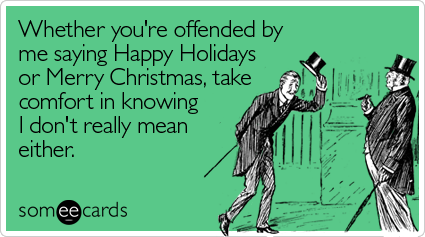
Merry Nonspecific Occasion Where We Give Gifts for Unspoken Reasons.

I am a conscientious objector to the WAR ON THE WAR  ON CHRISTMAS. To sum up my non-enthusiasm to be mad about people not using the proper greetings at the Shell station, I give you these non-joyful cards from someeecards.com.

Friday, December 16, 2011

A Calvin and Hobbes Christmas

Calvin and Hobbes is sorely missed. Many of our target readership may not even remember the adventures of a boy and his (maybe) imaginary tiger but thanks to the internet, the spirit still lives on. Above is one of the great tropes of the strip: Calvin's macabre display of snowmen in very inappropriate positions and situations. This made any Southern boy jealous for snow. Who wouldn't want to make a snow murder scene? Huh? WHO???

Ahem..

This is one of the best tributes of the snowmen I've seen and apt for the season:

Wednesday, December 14, 2011

NO CHRISTMAS DECORATIONS!!!

It was sort of a non-issue growing up. When my mom was ready, she'd go up in the attic and we'd pull out the Christmas decorations; tree ornaments, garlands, plastic elves (my favorite!), felt reindeer, and so on and put them up. Just did it. Maybe a week or two before Christmas. We'd get our tree from the high school's Christmas tree sale where old Mr. Radigan would take our money and offer us coffee. That was about 2 weeks before Christmas. All was calm, all was bright.

Then it seemed that priests and sisters and lay minsters began to say with the DOGMATIC AUTHORITY OF STUFF THAT THEY HEARD IN A WORKSHOP: "NO CHRISTMAS DECORATIONS BEFORE CHRISTMAS!" The offense they'd take when they'd see a creche or a reindeer in a church office would throw them into a liturgical rant unlike (seriously) any they have at any other time of year! Even some priests said, "NO CHRISTMAS PARTIES! WE CALL THEM 'ADVENT PARTIES'". When you take the "Christmas" out of "Christmas" party, even though it's all the same thing, it still sucks a little bit more.

So anyway, I saw this picture today of the Pope. Today. The Pope.
 
  Pope Benedict XVI leads his general audience in Paul VI hall at the Vatican Dec. 14. The hall's Nativity scene was handcrafted in Mexico. The Christmas tree is from Ukraine. (CNS/Paul Haring)

 So, there.

Tuesday, December 6, 2011

Would the real St. Nicholas please stand up?

Today we get to celebrate the icon of American childhood: Santa Claus. The real Santa Claus.

There are few Catholic traditions more pervasive throughout all of American culture than the man in red. In the past century, he has become a well-known symbol of the Christmas season and you'd be hard-pressed to find someone (no matter what their religious persuasions) who couldn't identify Santa.

We know all about him, right? He lives at the North Pole. He wears a red, furry suit. He hangs out with elves and rides a flying sleigh pulled by reindeer. And - most importantly - he sneaks into people's homes during the night before Christmas, and delivers presents. That last part is a little creepy when you really think about it... but I digress.


So who is the real Santa Claus? Well, truth is, the idea of Santa is based on a man who lived many centuries ago and wasn't all gingerbread and sugar plums. Instead, it seems that he was one tough cookie with a soft heart for the poor. His dress? Almost certainly not a red, fur-trimed suit. Instead, he wore the normal dress of fourth century men of his region - a tunical or a casula. And his home? Far from roaming reindeer or the snow of the North Pole - it was a town on the Mediterranean coast in modern-day Turkey. One thing that might be familiar: he probably did have a beard. His name was Nicholas.

As with most early saints, we don't know a whole lot about Nicholas. He was likely born around the year 270 in the city of Patara in Asia Minor (modern-day Turkey). Stories that have been preserved throughout the centuries, tell of a man who took his Catholic faith very seriously. Tradition records that Nicholas was the only child of wealthy parents. His parents died when he was a child - victims of an epidemic in the region, and Nicholas was raised by a devout uncle (also named Nicholas) who led the young man to be very active in the Church from an early age.

By the first decades of the fourth century, Nicholas was the bishop of Myra (now known as Demre), on the Mediterranean coast of Turkey. He led his local congregation through difficult years of the Diocletian Persecution - the most widespread and deadliest of the Roman persecutions against the Church. In 325, Nicholas participated at the Council of Nicaea - the first ecumenical (i.e. worldwide) council of the Church's bishops. There, Nicholas was numbered among the bishops, priests and deacons (including many who had been maimed during the last persecution), in a meeting called by the Roman Emperor Constantine to address the Arian teachings which were spreading through the Church at the time.

Arius was a priest in the city of Alexandria, Egypt - an important city for the Church at that time. He taught that God the Father existed before, and was superior to, the Son. This was not "the faith once delivered to the saints" and passed down from the Apostles (Jude 1:3). It was a novelty, but a popular one which was quickly spreading throughout the Roman Empire and sewing division in the Church. Constantine called the Church's bishops to Nicaea to make a formal decision on the teachings of Arius.

One story records that Arius stood in front of the assembled bishops and the emperor himself, and explained his teaching that Christ was homoiousious (of a similar nature) instead of homoousious (of the same nature) as God the Father. As he explained his position, one bishop - Nicholas - stood up, calmly walked over to Arius and slapped him across the face in front of everyone.

Nicholas lays the smack down on Arius at the Council of Nicaea.
Yes, Nicholas took his faith very seriously.

Another well-known story about Nicholas tells of how, while he was Bishop of Myra, he heard about a poor widower in the town who had three daughters for whom he could not afford to pay a dowry. This, of course, meant that they would not be married and, in that time and culture, had a very uncertain future. Nicholas took it upon himself to remedy this situation in a clever way that would preserve Nicholas' modesty and would protect the man from the humiliation of having to receive charity. In the dark of night, Nicholas tossed three pouches of gold coins into the open window of the man's home and then snuck away in the darkness. The coins were just enough to pay the dowry for each of the man's daughters. The man caught up with Nicholas and thanked him, but Nicholas modestly told the man to thank God alone and asked him not to tell others about his act of anonymous generosity. (By the way - if you've ever noticed the symbol of the three gold balls that many pawn shops use, it comes from this story - St. Nicholas is the patron saint of pawn brokers). 

From this story, it is easy to see how St. Nicholas became associated with gift-giving. In fact, it is on the night before this day (not the night of December 24th) when many children in Europe receive gifts "from St. Nicholas." Here in the United States, the Dutch version of St. Nicholas, Sint Nicolaas, and its abbreviated form, Sinterklaas, became corrupted into the now familiar Santa Claus. Clement C. Moore's famous poem, A Visit From St. Nicholas (you know: "T'was the night before Christmas..."), first published in 1823, went a long way to spread the popularity (and form the American version) of a jolly man who visits children during the Christmas season, bringing them gifts. You can also thank some great illustrations and advertising from the 19th and 20th centuries, which have cemented our American ideas about who Santa Claus is and what he looks like.

Interestingly, we may have a really good idea about what the real St. Nicholas looked like. In 2005, the remains of St. Nicholas - which had been "translated" (i.e. moved) from his original tomb in Myra to Bari, Italy in 1087, after the Muslim Turks took over control of Myra - revealed that he stood barely 5 feet tall and, at one point, had suffered a broken nose. Based on the measurements of his bones, forensic scientists created a computer-generated image of what St. Nicholas might have looked like. (see below)

In any case, on a day like today, it's best to celebrate this great saint of the Church by emulating his actions. Do something nice for someone, anonymously. Help someone in need, anonymously. Do it for the glory of God and the good of your soul. And be like St. Nick!

Forensic reconstruction of St. Nicholas, based on his skull.